The History and Evolution of NeuroMuscular Taping (NMT)
From Traditional Therapeutic Bandaging to an Innovative Decompressive Rehabilitation Methodology
 The use of bandages for therapeutic purposes dates back thousands of years to ancient Greek and Roman civilisations. One of the earliest artistic representations of therapeutic bandaging appears in classical Greek imagery depicting Achilles tending to the wounds of Patroclus, reflecting the longstanding use of bandages to protect injured tissues, control bleeding and support the initial stages of healing. Throughout history, bandaging techniques have evolved alongside medical knowledge, progressing from simple protective dressings to increasingly sophisticated therapeutic applications.
During the late twentieth century, the development of elastic adhesive tapes introduced new possibilities in sports medicine, physiotherapy and musculoskeletal rehabilitation. Many conventional taping approaches use different degrees of tape tension to provide mechanical support, sensory stimulation or compressive effects on the underlying tissues. These techniques became particularly widespread in athletic training, injury prevention and sports-related rehabilitation.
The Development of the NeuroMuscular Taping Concept in Italy
Beginning in 2000 and formally established in Rome in 2003, David Blow developed the NeuroMuscular Taping (NMT) Concept, introducing a distinctive therapeutic methodology based primarily on decompression and dilation rather than tension-based mechanical support. This development marked an important conceptual distinction in the application of elastic adhesive tape. Instead of relying on tape tension to create a mechanical or compressive effect, the NMT methodology uses specific application procedures designed to produce a decompressive interaction between the skin, superficial fascia and underlying tissues.
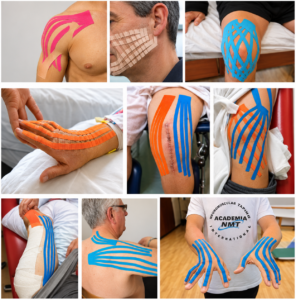
The defining characteristic of NMT decompressive taping is the application of elastic adhesive tape with zero tension (0%), while the skin and the relevant body region are positioned in functional elongation. When the body returns to its neutral position, characteristic skin convolutions become visible beneath the tape. These visible folds are a distinguishing feature of the NMT application methodology and form part of its proposed mechanical and sensory effects. The NMT Concept was subsequently developed into a structured rehabilitation system integrating functional anatomy, neurophysiology, lymphatic and vascular considerations, clinical assessment and specific treatment protocols for different pathological conditions and stages of recovery.
NeuroMuscular Taping Versus Kinesiology Taping: Understanding the Difference
The terms Kinesiology Taping, Kinesio Taping and NeuroMuscular Taping are frequently used interchangeably. However, although these approaches may use similar elastic adhesive materials, they should not automatically be considered identical therapeutic methodologies. The fundamental distinction lies in the application principles, the role of tape tension and the clinical objectives.
Conventional elastic taping approaches may use varying degrees of tape tension to provide mechanical support, influence movement or deliver sensory stimulation. In contrast, the NMT decompressive methodology is characterised by zero-tension applications, specific positioning of the body tissues during application and the formation of visible skin convolutions when the treated region returns to its resting position.
Within the NMT Concept, the therapeutic strategy is not simply determined by the anatomical location of the tape. It also involves the selection of application direction, anatomical sequencing, tissue positioning and rehabilitation objectives according to the patient’s clinical presentation. This distinction is particularly important because NMT is not defined by the tape itself, but by the methodology, clinical reasoning and application procedures used by the trained professional.
From an Innovative Concept to an International Rehabilitation Education System
Following the establishment of the NeuroMuscular Taping Institute in Rome in 2003, the NMT Concept evolved into an international professional education and clinical development program. The Institute was created to organise, standardise and disseminate the NMT Know-How, including its application principles, specialised training pathways, clinical protocols and professional competency requirements.
 Through collaborations with universities, hospitals, rehabilitation centres and professional education organisations, NMT training has expanded across Europe, North and South America, Asia, Africa and Australia. The Institute’s educational activities focus on the responsible transmission of the NMT methodology through theoretical instruction, supervised practical training, clinical reasoning, competency assessment and continuing professional development. Its work also includes scientific research initiatives, international educational collaborations and humanitarian rehabilitation projects.
The NMT Know-How and associated intellectual property provide the methodological foundation for the Institute’s professional training programs, supporting consistency in education, application procedures and clinical practice.
Clinical Applications of NeuroMuscular Taping
The NMT methodology has been developed for integration into a broad range of healthcare and rehabilitation disciplines, including orthopaedic and neurological rehabilitation, lymphatic and vascular management, postoperative recovery, oncology rehabilitation, paediatrics, occupational therapy, speech therapy and sports medicine.
Depending on the clinical condition and rehabilitation phase, NMT applications may be incorporated into therapeutic strategies addressing pain, oedema, tissue mobility, muscular discomfort, movement limitations, scar restrictions and functional recovery. Particular attention is given to the transition between acute, post-acute and functional rehabilitation, allowing practitioners to adapt application procedures to changing tissue conditions, clinical objectives and patient needs.
The proposed physiological effects of decompressive NMT include changes in superficial tissue mechanics, cutaneous sensory input and local fluid dynamics. These mechanisms remain areas of clinical and scientific investigation, and the strength of evidence varies between applications and patient populations. Rather than replacing established medical or rehabilitation treatments, NMT is intended as a complementary therapeutic methodology, integrated into individualised treatment plans and multidisciplinary healthcare strategies.
NeuroMuscular Taping: A Methodology Built on Decompression, Education and Clinical Reasoning
More than two decades after its formal development, the NeuroMuscular Taping Concept continues to evolve through professional education, clinical experience and scientific investigation. Its defining principle remains consistent: the use of specific zero-tension elastic taping applications to create a decompressive therapeutic approach, guided by anatomical knowledge, functional assessment and individual patient requirements. Through its international training programs, clinical protocols and research collaborations, the NeuroMuscular Taping Institute continues to promote the responsible development of NMT as a specialised methodology within contemporary rehabilitation.
NeuroMuscular Taping is more than an elastic tape application. It is a structured rehabilitation concept based on decompression, clinical reasoning and the integration of therapeutic techniques into patient-centred healthcare.
THE NEUROMUSCULAR TAPING INSTITUTE ®
The Training and Education Division of the NeuroMuscular Taping Institute
The NeuroMuscular Taping Institute’s Training and Education Division was established to design, coordinate and deliver specialised professional education programs. Course certification reflects our commitment to continuing education, maintaining high teaching standards and ensuring effective learning outcomes for healthcare professionals. Our rehabilitation and healthcare training programs provide Continuing Medical Education (CME/ECM) credits, where accredited and applicable, in accordance with the regulations of the countries in which courses are delivered. NMT education follows a strict “NO CONFLICT OF INTEREST” policy, promoting scientific independence, professional integrity and transparency.
Since January 2011, SAVÀ Rehabilitation Services, the organisation managing the NeuroMuscular Taping Institute, has maintained recognised quality standards for professional training, reflecting its commitment to continuous improvement, educational excellence and the effectiveness of its teaching programs.
Founded by David Blow, following years of clinical experience and research in medical rehabilitation, the NMT Institute was established in Rome in 2003. Its international activities subsequently expanded to New York (2012), Africa, including Congo and Ethiopia (2013), Indonesia (2015), South America (2016), Malaysia (2017), Australia (2023) and Rep. Korea (2026). Alongside developing and supervising the Institute’s international teaching team, David Blow personally delivers training in hospitals, universities, rehabilitation centres and private healthcare facilities. Today, the NeuroMuscular Taping Concept (NMT Concept) is integrated into professional education and clinical rehabilitation practices across public hospitals and private healthcare institutions internationally.


MISSION STATEMENT
The NeuroMuscular Taping Institute® is dedicated to advancing healthcare and rehabilitation through innovative, evidence-informed continuing professional education. Our mission is to provide healthcare professionals with specialised knowledge, practical skills and structured clinical protocols based on the NeuroMuscular Taping (NMT) decompressive methodology, promoting excellence in rehabilitation, multidisciplinary collaboration and patient-centred care.
Our objective is to improve rehabilitation outcomes, support functional recovery and enhance patients’ quality of life through the responsible integration of NMT into clinical practice. With comprehensive training programs covering multiple medical and rehabilitation disciplines, delivered by qualified and certified international instructors, we are committed to developing professional competence, strengthening clinical reasoning and providing healthcare practitioners with effective, practical therapeutic skills that support their patients in achieving healthier, more active and independent lives.
PHILOSOPHY


RESEARCH AND DEVELOPMENT
The Research and Development (R&D) Division of the NeuroMuscular Taping Institute® is dedicated to advancing rehabilitation through clinical observation, structured treatment protocols, controlled clinical trials and collaborative scientific research. We believe that an innovative therapeutic concept must be supported by rigorous investigation, reproducible methodologies and measurable clinical outcomes. Our research activities aim to transform practical clinical experience into reliable scientific knowledge, contributing to the continuous improvement of rehabilitation strategies and patient care.
A central objective of the Institute is to ensure that the NMT Know-How developed over more than two decadesevolves into a clearly defined, standardised and reproducible body of clinical knowledge. Through structured professional education, consistent application procedures, clinical documentation and collaboration with healthcare institutions, we seek to establish a strong methodological foundation for both clinical practice and scientific investigation. Our guiding principle is that innovation must be accompanied by scientific validation, allowing therapeutic approaches to be critically evaluated, refined and responsibly integrated into evidence-based rehabilitation.
Evidence-Based Medicine and Scientific Publications
The NeuroMuscular Taping Institute® actively promotes Evidence-Based Medicine (EBM) through clinical research, scientific publications and collaborations with universities, hospitals and rehabilitation centres internationally. Our research interests encompass neurological, orthopaedic, lymphatic, vascular, postoperative and functional rehabilitation, with particular attention to evaluating the clinical outcomes and proposed physiological mechanisms of NMT decompressive applications.
Each academic year, university students, healthcare professionals and research collaborators contribute to clinical investigations, dissertations and research projects, some of which progress toward scientific publication. The Institute remains committed to supporting the development of well-designed clinical studies, standardised treatment protocols and transparent scientific reporting, strengthening the evidence base for NeuroMuscular Taping and identifying areas requiring further investigation. Explore our ongoing scientific activities and published research through the NMT Evidence-Based Medicine and Scientific Publications section.
NEUROMUSCULAR TAPING INTELLECTUAL PROPERTIES
The NeuroMuscular Taping Institute® has pioneered the development of the NeuroMuscular Taping (NMT) Concept, a distinctive rehabilitation methodology based on elastic decompressive taping applications using zero tension (0%). Developed in Italy by David Blow, the NMT Concept represents a structured approach to therapeutic taping, integrating functional anatomy, neurophysiology, lymphatic and vascular considerations, and individualised clinical reasoning. Today, the methodology is taught and applied internationally across numerous healthcare disciplines, including physiotherapy, neurological and orthopaedic rehabilitation, sports medicine, nursing, occupational therapy, speech and language pathology, paediatrics and postoperative rehabilitation. NMT is designed as a complementary therapeutic tool that may support pain management, tissue mobility, oedema rehabilitation and functional recovery within established medical and rehabilitation programs.
The Development of NMT Know-How and Intellectual Property
The foundations of the “NMT Know-How” and “NMT Intellectual Property” were established by David Blow beginning in 2000 and consolidated in 2003 with the formal development of the NeuroMuscular Taping Concept and the establishment of the NeuroMuscular Taping Institute in Rome. This specialised body of knowledge encompasses the methodological principles of decompressive taping, application procedures, clinical reasoning strategies, educational materials and treatment protocols developed for different pathological conditions and rehabilitation phases.
The Institute plays a central role in preserving, developing, standardising and transmitting NMT professional know-how through certified educational programs, supervised practical training, scientific research and international academic collaborations. Since its foundation, the Institute has promoted innovative continuing education initiatives while actively supporting humanitarian rehabilitation projects and professional training opportunities in different regions of the world.
Through structured education and collaboration with universities, hospitals, research institutions and healthcare organisations, the NMT Institute aims to make its specialised knowledge accessible to qualified professionals while maintaining the methodological consistency, educational quality and professional standards associated with the NMT Concept. This commitment ensures that the principles and practical applications of NeuroMuscular Taping continue to evolve through clinical experience, scientific investigation and responsible knowledge sharing.
Information and Professional Enquiries
For information regarding NMT intellectual property, professional training, educational collaborations, research partnerships or authorised use of NMT teaching materials, please contact the NeuroMuscular Taping Institute.
Email: info.taping@gmail.com
