NeuroMuscular Taping for knee rheumatoid arthritis provides an evidence-informed rehabilitation approach that complements medical management by addressing pain, edema, joint stiffness and functional limitations. Through its decompression methodology, NeuroMuscular Taping (NMT) promotes lymphatic drainage, improves microcirculation, enhances proprioceptive feedback and supports more efficient movement. By reducing interstitial pressure around the inflamed knee joint, NMT may help improve mobility, facilitate daily activities and enhance quality of life for individuals living with rheumatoid arthritis.
Understanding Knee Rheumatoid Arthritis
Rheumatoid arthritis (RA) is a chronic autoimmune disease that progressively affects synovial joints, producing persistent inflammation, pain, swelling and structural damage. The knee is one of the most frequently involved joints, and chronic inflammation can impair gait, reduce muscle activation, limit joint mobility and diminish overall functional independence. Although pharmacological therapies remain the cornerstone of disease management, many individuals continue to experience pain, recurrent effusion and movement restrictions despite optimal medical treatment.
NeuroMuscular Taping for knee rheumatoid arthritis introduces a decompression-based rehabilitation strategy that complements conventional physiotherapy and medical care. Rather than relying on compressive support, NeuroMuscular Taping gently lifts the skin and superficial fascia to reduce interstitial pressure, facilitate lymphatic and venous drainage, improve microcirculation and enhance proprioceptive input. Furthermore, this continuous mechanical stimulation may contribute to improved neuromuscular control, greater joint mobility and reduced pain during functional activities. By integrating evidence-informed rehabilitation principles with individualized clinical reasoning, NeuroMuscular Taping offers a practical adjunctive approach for optimizing function and quality of life in people living with knee rheumatoid arthritis.
NeuroMuscular Taping plays a valuable role in the rehabilitation of knee rheumatoid arthritis by promoting joint mobility, reducing pain and edema, enhancing proprioception, and improving functional independence and quality of life.
Chronic Inflammation and Functional Decline
Rheumatoid arthritis (RA) is a chronic, systemic autoimmune disease characterized by persistent synovial inflammation and progressive joint destruction. The knee—being one of the largest and most load-bearing joints—is frequently affected, leading to swelling, pain, deformity, and significant mobility limitations.
The inflammatory process damages the synovial membrane and articular cartilage, producing effusion and hypertrophy that alter joint biomechanics. Over time, ligamentous laxity, quadriceps inhibition, and proprioceptive deficits compound the disability. In advanced stages, pain and stiffness reduce gait efficiency, limit participation in daily activities, and impair social independence.
Conventional therapy often combines disease-modifying antirheumatic drugs (DMARDs), corticosteroids, and physiotherapy. However, many patients continue to experience chronic pain, fluctuating edema, and restricted range of motion—especially during disease flares or post-surgical recovery. The challenge lies in managing inflammation and pain while preserving movement and function.
Prevalence and Societal Burden
Rheumatoid arthritis (RA) affects approximately 0.5–1% of the global population, with a higher incidence among women and older adults. A rarer but significant subset includes juvenile (pediatric) rheumatoid arthritis, which further complicates disease management due to its negative impact on growth cycles and bone development.
The knee joint is symptomatic in up to 70% of patients during the disease course, often leading to chronic pain, swelling, and functional limitation. Functional impairment caused by knee RA remains a major contributor to work disability, loss of independence, and reduced life expectancy. According to the World Health Organization (WHO), individuals with moderate to severe RA may lose an average of 8–10 years of healthy life as a result of complications and immobility. The economic burden is substantial, encompassing high medication costs, ongoing physiotherapy, and frequent surgical procedures such as synovectomy or total knee replacement, in addition to indirect costs related to reduced productivity and long-term care needs.
Given this scenario, there is a growing need for non-invasive, low-cost, and adjunctive treatments that can improve circulation, manage edema, and support mobility without pharmacologic side effects.
NeuroMuscular Taping and Tissue Decompression
NeuroMuscular Taping (NMT) introduces an innovative rehabilitation strategy using elastic, hypoallergenic tape applied to the skin to create a decompression or lifting effect on the underlying tissues. Unlike compression-based kinesiology taping methods, NMT’s decompressive application generates a localized negative pressure, promoting:
- Reduction of intra-articular pressure and effusion
- Improved venous and lymphatic drainage
- Enhanced proprioceptive feedback through mechanical decompression stimulation of cutaneous receptors
- Pain modulation via decreased nociceptive input and facilitation of normal movement patterns
In patients with knee RA, specific decompression patterns applied around the peripatellar, suprapatellar, and popliteal regions have shown measurable improvements in joint mobility and perceived comfort. The tape assists in repositioning the patella, reducing stress on inflamed synovium, and restoring quadriceps activation.
Integrating NeuroMuscular Taping into Rheumatoid Arthritis Rehabilitation
Recent pilot studies and clinical observations support NMT as a complementary intervention for inflammatory knee disorders. Patients treated with decompression taping demonstrate immediate decreases in pain intensity (VAS scale), reduction in edema volume, and improved knee flexion-extension arc within 24–72 hours.
When integrated into multidisciplinary rehabilitation—alongside physiotherapy, hydrotherapy, or occupational therapy—NMT optimizes therapeutic outcomes by maintaining tissue elasticity between sessions and minimizing post-exercise inflammatory responses.
Practical considerations for clinical application include:
- Acute phase fan-shaped or web patterns placed over anterior and posterior aspects of the knee joint swelling to facilitate lymphatic drainage.
- Functional phase of wide (5 cm, 2.5 cm) tape “Y” strips for deeper tissue or tendon decompression support assisting in flexion and extension coordination
- Zero to 10% tension during application to ensure true decompression.
- Regular skin assessment and patient education for safe home use.
Importantly, NMT is non-pharmacologic, does not interfere with ongoing DMARD therapy, and allows full joint mobility—essential for maintaining muscle activity and preventing contractures.
Key Clinical NMT Application: The Knee Double Fan Technique
Material elaborated by Daniele Carlesi, Raffaella Ruocco (2025)
One of the most effective and historically significant NeuroMuscular Taping applications for knee pathology is the Knee Double Fan Technique, developed by David Blow in 2000. This decompression-based taping method represents a milestone in the management of acute knee conditions—including rheumatoid arthritis, osteoarthritis, post-surgical edema, and post-traumatic swelling. Its dual anterior–posterior configuration facilitates drainage, reduces intra-articular pressure, and restores physiological movement through targeted mechanical decompression.
Application Parameters
- Length: 2 × 30 cm and 1 × 25 cm
- Width: 5 cm
- Anchor: 2 cm
- Shape: Five-strip fan
- Tension: 0% (complete decompression)
First Application – Anterior Double Fan (30-35 cm)
Patient position: Seated on the treatment table with the knee flexed and aligned with the hip and ankle.
- Identify the midpoint of the third strip (excluding the anchor); this will correspond to the center of the patella.
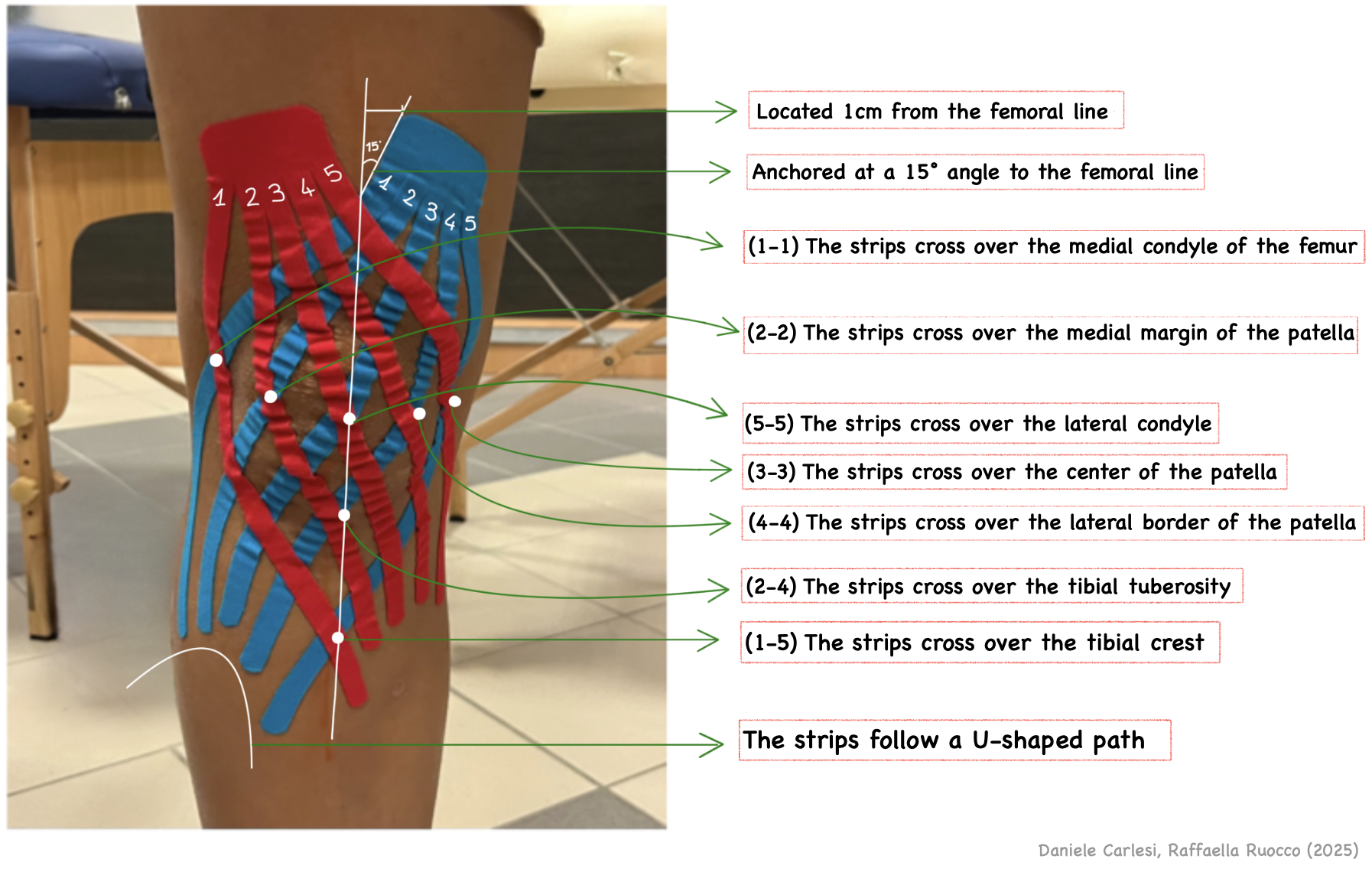
- Apply the anchor 1 cm lateral to the femoral line at a 15° angle.
- Maintain the knee in approximately 110° of flexion, within its physiological range.
- Begin taping from the medial side, proceeding sequentially:
- Strip 1: Cross over the medial femoral condyle, follow the tibial crest, and extend toward the lateral malleolus.
- Strip 5: Cross over the lateral femoral condyle toward the lateral malleolus.
- Strip 2: Cross over the medial patellar border, pass the tibial tuberosity, and continue toward the lateral malleolus.
- Strip 4: Cross over the lateral patellar border toward the lateral malleolus.
- Strip 3: Center over the patella and extend toward the lateral malleolus.
For the lateral fan, repeat the same procedure and reference points, but orient the strips toward the medial malleolus instead.
This anterior configuration creates a balanced decompression pattern over the peri-patellar region, facilitating drainage and reducing anterior knee pressure during inflammation or after surgery.

Second Application – Posterior Fan (25-30 cm)
Patient position: Standing upright with the knee in a natural, slightly flexed physiological extension. Correct any hyperextension before taping and ensure alignment of the hip, knee, and ankle.
- Identify the midpoint of the third strip (excluding the anchor); position it at the center of the popliteal fossa.
- All strips should terminate along a single horizontal line across the posterior knee.
- Apply the strips in the following sequence:
- Strip 1: Lateral to the lateral border of the popliteal fossa.
- Strip 5: Lateral to the medial border of the popliteal fossa.
- Strip 3: Perpendicular, centered directly over the popliteal fossa.
- Strips 2 and 4: Positioned 1 cm apart between the central and outer strips.
This posterior fan enhances vascular and lymphatic outflow from the joint cavity and popliteal region, complementing the anterior decompression and ensuring a 360° circulatory effect.
Clinical Applications and Patient Outcomes
Clinical Rationale and Benefits: The Double Fan Technique acts on both the superficial and deep drainage networks, targeting the synovial and periarticular tissues most affected in inflammatory and degenerative knee conditions. When applied with zero tension, it creates alternating zones of negative pressure, improving microcirculation and reducing pain while preserving full range of motion.
Clinically, this method has demonstrated:
- Rapid edema reduction in acute inflammatory episodes
- Improving blood flow and oxygenation to synovial and periarticular tissues
- Decreased pain intensity and stiffness
- Improved knee flexion-extension range
- Enhanced post-surgical recovery and tolerance to rehabilitation exercises
By integrating this technique into early and functional rehabilitation stages, clinicians can accelerate recovery and maintain long-term functional stability in patients with rheumatoid or osteoarthritic knee involvement.
See the LINKEDIN NMT Newsletter

Are you interested in enrolling in an NMT Course?
The NeuroMuscular Taping Institute provides certification courses in physical rehabilitation, neurology, oncology, post surgical rehab, occupational therapy, speech therapy, remedial therapy, nursing as well vascular and lymphedema treatment and management. All trainings are classroom settings to enhance skill development and clinical reasoning creating optimum therapeutic results. ONLINE courses are not available. Please contact your local course provider or visit the NMT WEB SITE for course programs and dates.
For more details, course listings, and registration for an upcoming course CLICK HERE
Do you require validation of your NMT methodology for research purposes?
A detailed Neuromuscular Taping methodology is crucial in any research project for several reasons. Repeatability, Transparency, Validity and Reliability of your treatment choices will not only have an impact on your research but also an impact on future therapeutic choices. For more detailed information about the NMT, please contact us at: info.taping@mail.com
Know someone who might be interested in this newsletter? Share it with them.