Cochlear implant rehabilitation is an essential component of successful hearing restoration following cochlear implant surgery. While the surgical procedure provides direct stimulation of the auditory nerve, long-term outcomes depend on structured rehabilitation that promotes neuroplasticity, auditory processing, sensorimotor integration and tissue healing. NeuroMuscular Taping (NMT) complements this multidisciplinary approach by supporting lymphatic drainage, reducing postoperative edema, improving microcirculation and enhancing neurosensory input, thereby creating favourable conditions for both peripheral recovery and central nervous system adaptation.
Introduction
Cochlear implantation has transformed the treatment of severe to profound sensorineural hearing loss, offering patients the opportunity to regain functional hearing and improve communication. However, surgery represents only the first stage of recovery. Cochlear implant rehabilitation is a comprehensive, multidisciplinary process that combines auditory training, speech and language therapy, vestibular rehabilitation, sensorimotor integration and neuroplastic adaptation to maximize functional outcomes.
Furthermore, successful rehabilitation extends beyond auditory processing alone. Postoperative edema, scar formation, pain, vestibular disturbances and cranial nerve dysfunction can influence recovery and patient comfort during the early healing phase. NeuroMuscular Taping (NMT) introduces a decompression-based rehabilitation strategy designed to improve lymphatic drainage, optimize microcirculation, reduce interstitial pressure and enhance neurosensory feedback. By integrating tissue healing with functional neurorehabilitation, NMT may support both peripheral recovery and the central neuroplastic processes that are fundamental to successful cochlear implant outcomes.
Understanding Cochlear Implant Surgery
Accurate diagnosis is essential to determine candidacy for cochlear implantation. Patients typically present with:
- Severe to profound sensorineural hearing loss
- Limited or no benefit from conventional hearing aids
- Speech recognition difficulties, even with amplification
Diagnostic assessment involves:
- Audiological evaluation (pure tone audiometry, speech perception tests)
- Imaging studies (CT and MRI of the temporal bone and cochlea)
- Medical and neurological evaluation
- Psychological and cognitive assessment, particularly in pediatric or elderly patients
The goal is to identify patients who will benefit not only from the device itself, but from the intensive rehabilitation that follows.
The Goals of Cochlear Implant Rehabilitation
Cochlear implantation is recommended when auditory deprivation significantly impacts communication, development, or quality of life. Common indications include:
- Congenital or early-onset deafness (critical in language development)
- Progressive hearing loss unresponsive to amplification
- Post-infectious, traumatic cochlear damage or unclear causes
- Reduced Trigeminal sensorimotor activity and trigeminal neuralgia and subsequent tinnitus
- Bilateral severe hearing impairment affecting social participation
In children, early implantation supports language acquisition and cognitive development. In adults, it restores communication abilities, reduces social isolation, and improves overall functional independence.
Neuroplasticity and Auditory Relearning
Cochlear implantation must always be integrated within a structured rehabilitation program. The primary objectives extend beyond sound detection and include:
1. Auditory Perception and Discrimination. Patients must learn to interpret new auditory signals. This involves:
- Sound detection and differentiation
- Speech recognition and comprehension
- Auditory memory and processing
2. Neuroplastic Adaptation
The brain must reorganize in response to new sensory input. This aligns with modern neurorehabilitation principles, where repeated exposure and variability enhance cortical re-mapping.
3. Speech and Language Development. Particularly critical in pediatric patients:
- Development of phonological awareness
- Speech production and articulation
- Language comprehension and expression
4. Sensorimotor and Vestibular Integration. Given the close anatomical and functional relationship between the cochlea and the vestibular system:
- Balance training may be required
- Postural control and spatial orientation must be re-integrated
- Alterations affecting the vestibulocochlear nerve may result in symptoms such as dizziness, vertigo, and impaired spatial orientation, as well as altered auditory perception
5. Psychosocial Reintegration. Rehabilitation also addresses:
- Communication confidence
- Social participation
- Emotional adaptation to restored hearing
Risks and Complications Requiring Rehabilitation Focus
Although cochlear implant surgery is considered safe, complications—while rare—can significantly influence rehabilitation pathways. Common Surgical Risks include:
- Bleeding
- Swelling
- Infection around the implant
- Facial nerve injury and facial nerve stimulation are rare but important risks of cochlear implant surgery.
a) Auditory and Vestibular Symptoms. These symptoms often require targeted vestibular and neurosensory rehabilitation strategies.
- Tinnitus (ringing in the ears)
- Dizziness and vertigo
b) Neurological and Sensory Complications. These reflect involvement of adjacent neural structures and may require sensory retraining approaches.
- Numbness around the ear
- Changes in taste
- Dry mouth
c) Facial Nerve Involvement. This is a key area where integrated rehabilitation (including neuromuscular re-education and possibly adjunctive therapies such as NeuroMuscular Taping) can support recovery.
- Injury to the facial nerve may lead to facial movement dysfunction
d) Serious but Rare Complications:
- Leakage of cerebrospinal fluid
- Meningitis (infection of the membranes surrounding the brain)
- Complications related to general anesthesia
- Need for implant removal due to infection
The Role of Rehabilitation in Managing Complications
Complications do not represent failure—they define the need for a more tailored rehabilitation strategy. A structured approach includes:
- Vestibular rehabilitation for balance disorders
- Facial nerve rehabilitation for motor recovery
- Sensory modulation techniques for altered tactile or taste perception
- Lymphatic and vascular management to support tissue recovery and reduce edema
- Pain and scar management, particularly in post-surgical phases
From a NeuroMuscular Taping perspective, decompressive applications may support:
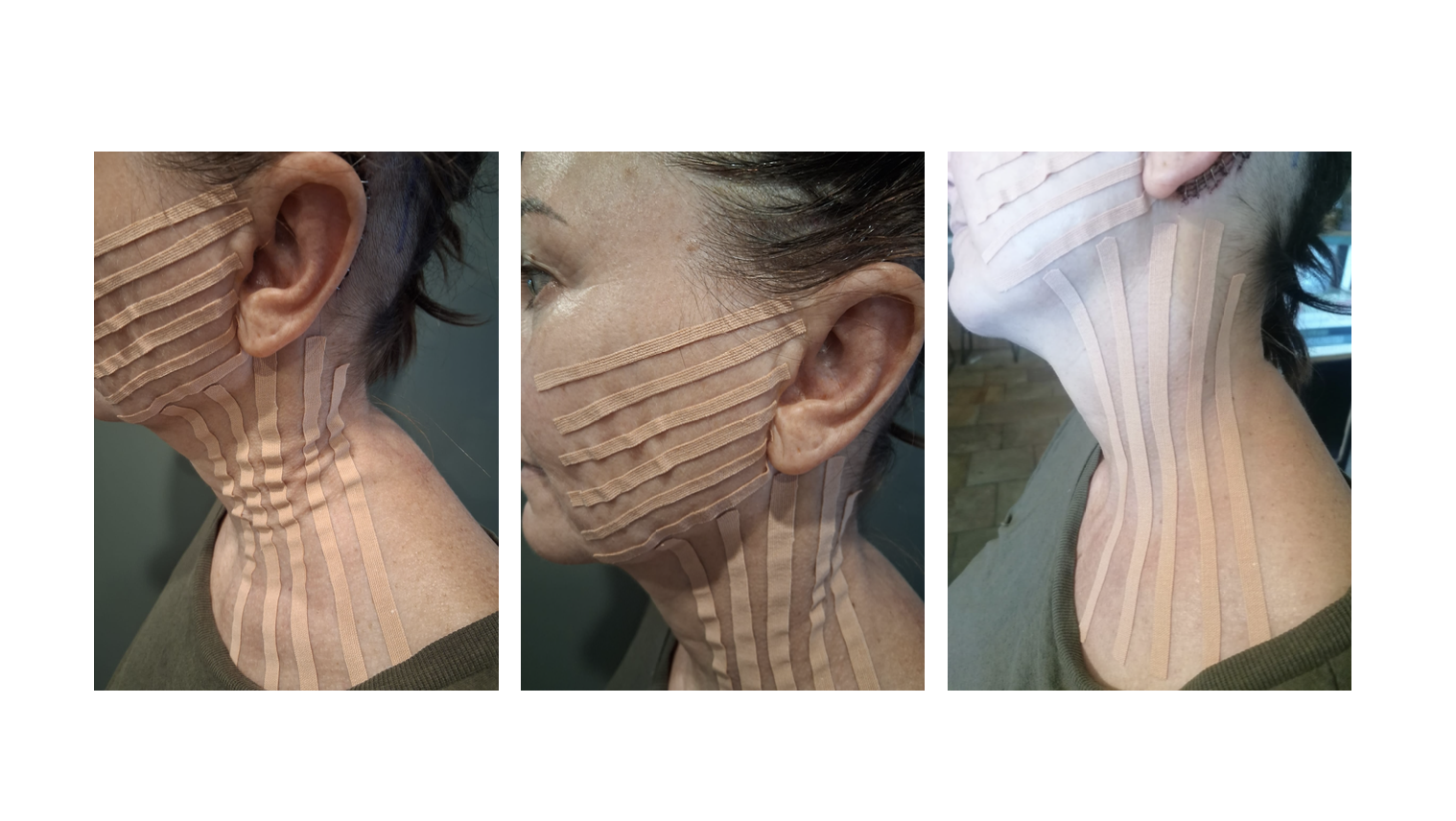
- Acute phase improving microcirculation and lymphatic drainage of the surgical site, anterior to the ear and lateral neck lymphatic nodes
- Reduction of local pressure and pain nociceptive input
- Improvement of tissue glide and sensory feedback
- Improve scar healing processes and reduce scar adhesion
- Improve balance control
- Language and speech therapy
NeuroMuscular Taping in Postoperative Rehabilitation
Rationale for NMT Integration: NeuroMuscular Taping, developed in Italy in the early 2000, is based on a decompressive, eccentrically applied taping method that lifts the skin, creating convolutions and increasing interstitial space. Correct NMT applications follow distinct therapeutic objectives and facilitates:
- Microcirculatory enhancement
- Lymphatic drainage
- Reduction of interstitial pressure
- Modulation of cutaneous and neurosensory input
- Reduction of deep and superficial scar adhesion
In cochlear implant patients, where surgery involves delicate neurovascular and fascial structures of the temporal and cervical regions, NMT becomes particularly relevant.
Clinical Objectives of NeuroMuscular Taping (NMT) in Cochlear Implant Rehabilitation
1. Post-Surgical Edema and Pressure Reduction
- Promote lymphatic drainage in the retroauricular, pre-auricular, and cervical regions
- Reduce local swelling and interstitial tissue pressure
- Optimize the biological environment for healing around the implant site
2. Pain Modulation
- Decrease nociceptive input through tissue decompression
- Improve patient comfort, particularly in the early post-operative phase
3. Scar Management and Tissue Mobility
- Enhance glide between skin, fascia, and underlying structures
- Prevent fibrotic adhesions that may alter local biomechanics
- Reduce deeper scar adhesions in the mastoid and retroauricular areas
4. Neurosensory Reintegration
- Enhance afferent sensory input from the cutaneous system
- Support cortical re-mapping processes associated with auditory rehabilitation
5. Facial, Trigeminal, and Vestibulocochlear Nerve Support
- Assist in cases of mild to severe facial nerve dysfunction
- Improve neuromuscular coordination and facial symmetry
- Reduce trigeminal nerve–related pain
- Enhance oculomotor–auditory coordination and balance control
6. Vestibular and Cervical Integration
- Reduce cervical tension that may influence vestibular function and balance
- Facilitate postural adaptation and head–neck coordination
7. Language and Speech Therapy Support
- Reduce cervical and submandibular tension that may affect phonation and articulation
- Facilitate optimal head–neck alignment to support respiratory–phonatory coordination
- Normalize swallowing dysfunctions and mastication coordination
- Enhance proprioceptive input relevant to oro-facial and vocal function
Integrating NeuroMuscular Taping into Cochlear Implant Rehabilitation
- Application with 0% stretch (eccentric decompression)
- Skin positioned in elongation prior to application
- Creation of visible skin convolutions (indicator of decompression)
Key Application Areas
1. Retroauricular and Temporal Region
- Application of fan-shaped or decompressive strips around the implant site
- Objective: reduce edema and improve local microcirculation
2. Cervical Lymphatic Pathways
- Directional applications oriented along lymphatic drainage pathways
- Objective: enhance fluid clearance and reduce interstitial pressure
3. Facial Region (if indicated)
- Targeted applications along facial nerve pathways and associated musculature
- Objective: support motor recovery and improve facial symmetry
4. Occipital and Upper Cervical Area
- Decompression of the cranio-cervical junction
- Objective: optimize vascular flow and neurosensory integration
5. Forehead, Ocular, and Temporal Region
- Decompressive applications targeting the periocular and frontal musculature
- Objective: optimize ocular vascularization and neurosensory dynamics, supporting oculomotor function
Clinical Implications and Future Directions
When integrated appropriately within a multidisciplinary rehabilitation program, NMT may contribute to:
- Faster reduction of post-surgical edema
- Decreased pain and improved patient comfort
- Improved scar quality and tissue mobility
- Enhanced proprioceptive and sensory feedback
- Better cervical and postural alignment
- Support in facial nerve recovery (when involved)
- Indirect facilitation of auditory rehabilitation through improved sensory environment
NMT in the Management of Surgical Risks and Complications
NMT plays a supportive role in addressing several post-operative challenges:
- Swelling and inflammation → lymphatic decompression
- Tinnitus and sensory disturbances → neurosensory modulation
- Dizziness and vertigo → cervical and vestibular integration
- Facial nerve impairment → neuromuscular facilitation
- Scar adhesions → tissue mobility restoration
While NMT does not replace medical or surgical management, it enhances the physiological environment in which recovery occurs.
“It is essential to distinguish NeuroMuscular Taping from tension-based taping methods. NMT is applied without stretch, creating visible skin convolutions that reflect a decompressive mechanism. This lifting effect is fundamental in post-surgical cochlear implant rehabilitation, where reduction of pressure, optimization of microcirculation, and facilitation of lymphatic flow are primary therapeutic goals.”
Conclusion
Cochlear implant rehabilitation requires a comprehensive, systems-based approach that integrates auditory, lymphatic, neurological, and musculoskeletal components. The inclusion of NeuroMuscular Taping expands therapeutic possibilities by addressing the often-overlooked dimensions of tissue physiology, fluid dynamics, and sensory modulation. In this context, NMT does not act as an isolated technique but as a facilitator—creating the optimal biological and mechanical conditions for the nervous system to adapt, reorganize, and ultimately restore meaningful auditory function.
See the LINKEDIN NMT Newsletter

Are you interested in enrolling in an NMT Course?
The NeuroMuscular Taping Institute provides certification courses in physical rehabilitation, neurology, oncology, post surgical rehab, occupational therapy, speech therapy, remedial therapy, nursing as well vascular and lymphedema treatment and management. All trainings are classroom settings to enhance skill development and clinical reasoning creating optimum therapeutic results. ONLINE courses are not available. Please contact your local course provider or visit the NMT WEB SITE for course programs and dates.
For more details, course listings, and registration for an upcoming course CLICK HERE
Do you require validation of your NMT methodology for research purposes?
A detailed Neuromuscular Taping methodology is crucial in any research project for several reasons. Repeatability, Transparency, Validity and Reliability of your treatment choices will not only have an impact on your research but also an impact on future therapeutic choices. For more detailed information about the NMT, please contact us at: david.blow@nmtinstitute.org
Know someone who might be interested in this newsletter? Share it with them.