NeuroMuscular Taping Decompression Terapia provides a systems-based approccio to myofascial treatment by addressing the continua interazione between skin, subcutaneous connective tissue, fascia, interstiziale fluido, vascular e lymphatic strutture, periferico sensoriale input e skeletal muscle. Applied with 0% therapeutic tape tensione while the anatomica regione is appropriatamente elongated, NMT creates characteristic skin convolutions when the body returns toward a neutral position. This continuously changing skin–tape interface may modify superficial tissue geometry e sensoriale input without mechanically forcing or restricting physiological movement.
From Mechanical Fascia to an Integrated Physiological System
Contemporary myofascial rehabilitation increasingly recognizes that fascia cannot be understood as an isolated mechanical structure surrounding muscles. Instead, the skin, subcutaneous tissues, superficial e deep fasciae, extracellular matrix, interstiziale fluido, microvasculature, lymphatic vessels, periferico nerves e skeletal muscles form an anatomically continua e physiologically interactive system. Consequently, myofascial treatment should consider not only stiffness, tensione e restricted mobilità, but also the biological environment in which tissue movement, sensoriale processing e neuromuscular function occur.
NeuroMuscular Taping Decompression Terapia offers a distinctive approccio within this model. Unlike elastic taping methodologies based on predetermined tape tensione, NMT applies elastic tape at 0% therapeutic tensione while the skin e underlying tissues are placed in an appropriate degree of elongation. As the anatomica regione returns toward neutral, characteristic cutaneous convolutions develop. Rather than forcing tissues into a predetermined position, this methodology creates a dynamic skin–tape interface that changes continuously during posture e movement.
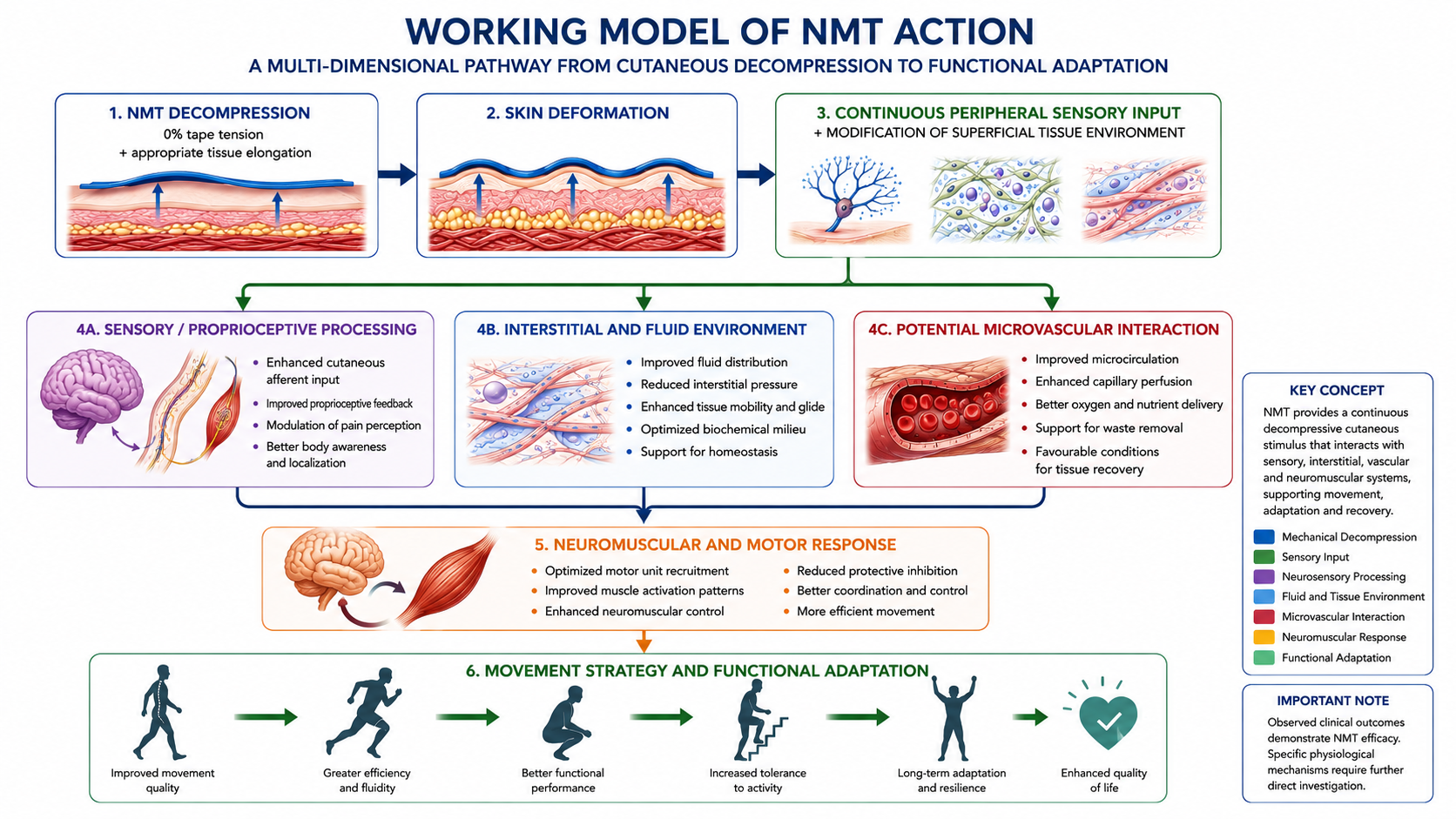
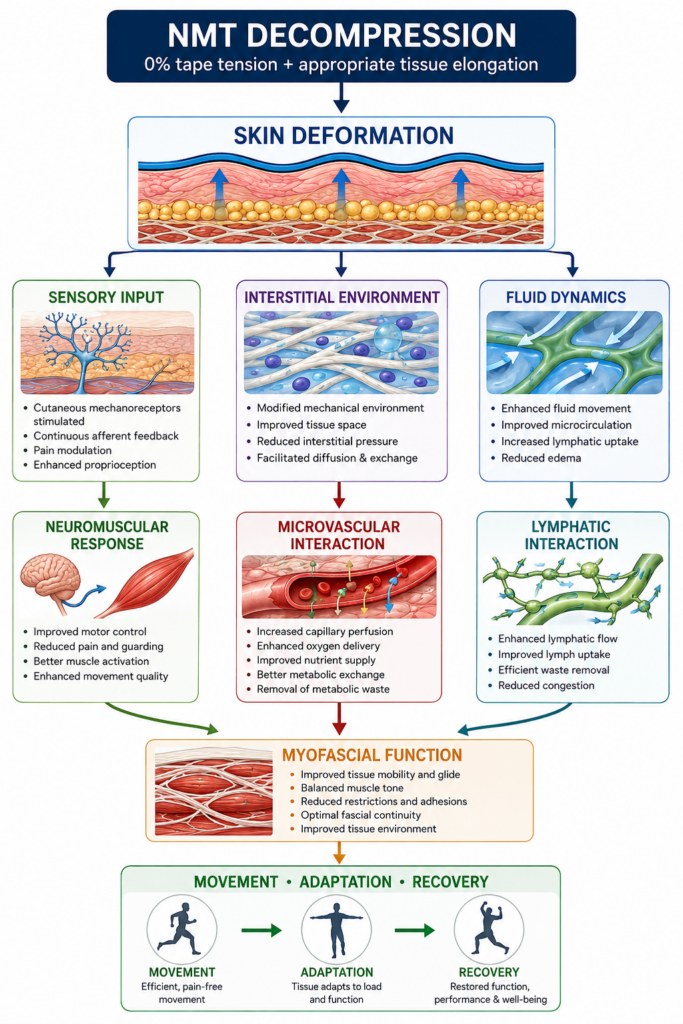
Furthermore, the potential importance of this decompressive interface extends beyond the visible skin response. Skin deformation occurs within a highly vascularized, innervated e fluido-dependent tissue environment. Changes in superficial tissue geometry may interact with interstiziale pressure, extracellular fluido movement, lymphatic transport, microvascular exchange e cutaneous sensoriale afference. Continuous periferico sensoriale input may subsequently influence proprioceptive processing, neuromuscular coordination e movement strategies. These interacting processes provide a physiological framework through which NMT can be investigated within contemporary myofascial rehabilitation.
However, clinical outcomes e physiological mechanisms should remain clearly distinguished. Improvements in pain, range of motion, muscular performance or functional outcomes following NMT do not, by themselves, demonstrate increased capillary perfusion, lymphatic flow or tissue oxygenation. Therefore, these vascular, lymphatic e metabolic interactions should currently be considered plausible components of an integrated physiological model requiring further direct experimental investigation.
David Blow. SAVA’ Health Services – NeuroMuscular Taping Institute, Rome, Italy.
August 2026. DOI: 10.13140/RG.2.2.19353.17764
The Skin–Fascia–Interstitial Interface
Contemporary myofascial rehabilitation increasingly recognizes that fascia cannot be understood as an isolated mechanical structure. Skin, subcutaneous connective tissue, superficial and deep fasciae, extracellular matrix, interstitial fluid, blood vessels, lymphatic vessels, peripheral nerves and skeletal muscle form an anatomically continuous and physiologically interactive system. Accordingly, the objectives of myofascial treatment extend beyond the mechanical reduction of stiffness or restriction and should also include improvement of tissue mobility, fluid homeostasis, pain modulation, sensory integration, neuromuscular coordination and functional movement. Current anatomical research describes the superficial fascia as a distinct, vascularized and innervated connective-tissue structure embedded within the subcutaneous tissues, further supporting an integrated skin–fascia model rather than viewing fascia as an inert wrapping around muscle (Stecco et al., 2011; Stecco et al., 2013; Fede et al., 2025).
NeuroMuscular Taping (NMT) is a decompressive methodology in which elastic tape is applied at 0% therapeutic tension while the anatomical region is positioned in an appropriate degree of elongation. Returning the body toward a neutral position produces characteristic cutaneous convolutions and creates a continuously changing skin–tape interface during posture and movement. Rather than mechanically forcing tissues into a corrected position, NMT is intended to provide prolonged cutaneous stimulation while modifying superficial tissue geometry and the local mechanical environment. This review examines the possible contribution of NMT to myofascial treatment through interactions involving skin deformation, interstitial fluid dynamics, microvascular exchange, lymphatic transport, sensory afference and neuromuscular regulation. Contemporary physiology demonstrates that microvascular perfusion is fundamental to oxygen and substrate delivery, while interstitial fluid and lymphatic transport are essential for maintaining the extracellular environment in which tissue exchange occurs (Levick and Michel, 2010; Wiig and Swartz, 2012; Poole, 2019).
NMT-specific clinical trials have demonstrated improvements in pain, range of motion, muscular performance and functional outcomes in selected musculoskeletal and neurological populations (Pillastrini et al., 2016; Costantino et al., 2016; Maggi et al., 2022). However, clinical improvement should not automatically be interpreted as evidence that NMT directly increases capillary perfusion, lymphatic flow or tissue oxygenation. These mechanisms remain plausible components of an integrated physiological model requiring further direct investigation.
Keywords: NeuroMuscular Taping; NMT; myofascia; fascia; decompression; microcirculation; lymphatic drainage; interstitial fluid; tissue oxygenation; mechanotransduction; proprioception; rehabilitation.
Principles of NeuroMuscular Taping Decompression Therapy
Myofascial treatment has historically been dominated by mechanical concepts such as shortening, stiffness, trigger points, fascial adhesions, muscular tension and restricted joint movement. These concepts remain clinically relevant, but they provide only a partial description of the biological environment in which musculoskeletal function occurs. Fascia is now increasingly understood as part of a complex three-dimensional system containing connective tissue, fluid, vessels and sensory structures and interacting continuously with skeletal muscle and skin (Stecco et al., 2011; Fede et al., 2025).
The superficial fascia is particularly important in this context because it lies between the dermis and deeper musculoskeletal structures. Contemporary anatomical descriptions identify it as a recognizable connective-tissue layer containing collagen and elastic components, adipose tissue, vascular structures and neural elements. Its morphology differs between body regions and is adapted to local requirements for mobility, protection and mechanical transmission (Stecco et al., 2013; Fede et al., 2025).
This anatomical organization means that tissue function cannot be separated easily into isolated compartments. Skin deformation influences subcutaneous tissues; muscular contraction alters fascial geometry; tissue movement changes pressure relationships; changes in extracellular fluid can modify the mechanical environment; and sensory information arising from skin, fascia, muscles and joints contributes continuously to motor control.
The interstitial compartment represents another important element of this system. Wiig and Swartz described the interstitium as the extracellular environment consisting of fluid, proteins, solutes and extracellular matrix surrounding tissue cells. Interstitial fluid originates predominantly through transcapillary filtration and is removed principally through the lymphatic system (Wiig and Swartz, 2012). Thus, every muscle fibre, fibroblast, peripheral nerve and vascular structure functions within an extracellular environment whose composition and fluid dynamics are continuously regulated.
This perspective is important clinically. Following trauma, inflammation, surgery or prolonged overload, local changes may involve increased vascular permeability, fluid accumulation, altered tissue pressure, nociceptive signalling, reduced mobility and muscular guarding. Reduced movement may subsequently diminish the contribution of muscle contraction and tissue deformation to local fluid transport, further modifying the tissue environment.
Myofascial rehabilitation should therefore aim not simply to “release fascia,” but to improve the conditions in which the entire neuromusculoskeletal system functions. Within this framework, NeuroMuscular Taping provides a potentially useful bridge between manual treatment and active movement. NMT begins with the skin but maintains its effect over many hours while the patient continues to move.
The therapeutic question therefore changes from one of mechanical correction to one of physiological interaction: How can a continuous decompressive cutaneous stimulus interact with the tissue environment in which fascia and muscle function?
The Skin–Fascia Continuum
A simplified anatomical model progresses from: Epidermis → Dermis → Hypodermis → Superficial fascia → Deep adipose tissue → Deep fascia → Epimysium → Muscle
Although this layered representation is convenient educationally, these structures do not function as completely independent sheets. The superficial fascia forms part of the subcutaneous architecture. Its morphology includes fibrous and adipose components and is influenced by region, age and mechanical requirements. Contemporary anatomical review has highlighted its vascularization, innervation and relationship with overlying and underlying tissues (Fede et al., 2025).
This arrangement creates an important clinical principle: skin deformation occurs at the surface of an integrated connective-tissue system. It would nevertheless be incorrect to assume that lifting the skin by several millimetres produces an equivalent lifting force within deep fascia or skeletal muscle. Mechanical effects become distributed through complex tissues and depend on local anatomy, tissue stiffness, body position and movement.
The more defensible model is therefore one of progressive transmission of deformation and changing mechanical relationships rather than direct deep-tissue lifting. This is relevant to NMT because the methodology intentionally uses the skin as the interface through which a prolonged mechanical and sensory stimulus is delivered.
NMT Decompression model
NeuroMuscular Taping Decompression Methodology
NeuroMuscular Taping differs conceptually from taping systems based principally on stretch, compression, mechanical correction or stabilization. The application begins by positioning the body or anatomical region into the required degree (physiological range) of elongation. Elastic tape is then applied without therapeutic stretch—0% tension.
When the region returns toward a more neutral position, the tape and skin do not return in exactly the same geometric manner. This creates characteristic cutaneous convolutions.
The treatment sequence is therefore: Assessment → tissue positioning → 0% tape application → return toward neutral → skin deformation → movement or activation → reassessment
The significance of 0% tape tension is fundamental. In a tension-based system, mechanical force is introduced by stretching the tape itself. In NMT, the body provides the initial tissue elongation. The tape subsequently interacts with the body as the body changes position beneath it.
This produces a fundamentally different therapeutic relationship: The tape does not mechanically place the body into a corrected position; the body moves continuously beneath, with and against the tape.
Visible convolutions provide direct evidence that the skin has been mechanically deformed. What they do not demonstrate by themselves is the precise magnitude of any change in interstitial pressure beneath the application. For this reason, terminology such as relative superficial decompression is scientifically preferable to claiming a uniform negative pressure or vacuum effect.
NMT-Specific Clinical Evidence
The clinical evidence base for NeuroMuscular Taping (NMT) has progressively expanded across musculoskeletal, neurological, vascular-connective tissue, wound-care, post-surgical and functional rehabilitation. Although the studies vary considerably in design, sample size and clinical population, collectively they demonstrate that decompressive NMT has been associated with measurable changes in pain, edema, mobility, muscle performance, gait, proprioceptive-cognitive strategies and selected local tissue responses. These findings are particularly relevant to the integrated myofascial model proposed in this review because they suggest that NMT should not be interpreted exclusively as a local mechanical intervention. Rather, its clinical effects may involve interactions among the cutaneous, sensory, interstitial, vascular, lymphatic and neuromuscular environments.
This developing literature supports a broader interpretation of NMT as a decompressive, sensory and movement-integrated rehabilitation intervention rather than simply a mechanical tape application. Importantly, the strength of evidence is not identical for every component. Clinical changes in pain, edema, gait, mobility and function have been observed, while the direct pathways linking decompression to microvascular perfusion, tissue oxygenation, lymphatic transport and central neuroplasticity remain areas requiring targeted mechanistic research.
From Tissue Environment to Functional Movement
The contemporary understanding of fascia supports a transition away from considering myofascial dysfunction as an isolated mechanical problem. Muscle and fascia function within an integrated skin–fascia–interstitial–vascular–lymphatic–neuromuscular environment.
Microcirculation provides oxygen and nutrients and supports metabolic exchange. Interstitial fluid forms the immediate extracellular environment of tissues, while lymphatic vessels regulate fluid and macromolecular return. Cutaneous afferents provide continuous sensory information, and skeletal-muscle contraction modifies both mechanical loading and local circulation.
NMT decompression methodology introduces a prolonged peripheral stimulus into this system. By applying elastic tape at 0% tension while the tissue is elongated, subsequent return toward neutral creates characteristic skin deformation. During movement, this relationship changes continuously, providing repetitive mechanical and sensory stimulation.
The scientifically defensible interpretation is that this decompressive environment may interact with superficial interstitial mechanics, fluid movement, microvascular exchange, lymphatic physiology and cutaneous sensory input, rather than that every one of these mechanisms has already been conclusively demonstrated.
Clinical NMT trials nevertheless show meaningful improvements in pain, range of motion, muscular strength and function in selected populations (Pillastrini et al., 2016; Costantino et al., 2016; Maggi et al., 2022). The most productive clinical model is therefore one in which myofascial treatment, NMT decompression and active movement are integrated rather than separated.
The therapeutic sequence can be summarized as: DECOMPRESS → MOVE → EXCHANGE → ADAPT → REASSESS
Within this framework, NMT is not simply an adhesive tape placed on a muscle. It becomes a prolonged interface between therapeutic intervention, tissue physiology and functional movement.
See the full article on ResearchGate
Ready to Advance Your Clinical Skills?
Are you interested in enrolling in a NeuroMuscular Taping (NMT) course? The NMT Institute offers internationally accredited certification programs across a wide range of clinical fields, including:
- Physical rehabilitation
- Neurology
- Oncology e post-surgical rehabilitation
- Sports therapy e athletic training
- Occupational e speech therapy
- Remedial education e nursing
- Vascular e lymphedema treatment e management
All NMT courses are delivered in-person in classroom settings, ensuring hands-on skill development, enhanced clinical reasoning, e optimal therapeutic outcomes. Online courses are not available, as practical application is central to the NMT therapeutic system.
To view upcoming course dates, detailed programs, e registration options, please contact your local course provider or visit the NMT Institute Website.

Are you interested in enrolling in an NMT Course?
The NeuroMuscular Taping Institute provides certification courses in physical rehabilitation, neurology, oncology, post surgical rehab, occupational therapy, speech therapy, remedial therapy, nursing as well vascular e lymphedema treatment e management. All trainings are classroom settings to enhance skill development e clinical reasoning creating optimum therapeutic results. ONLINE courses are not available. Please contact your local course provider or visit the NMT WEB SITE for course programs e dates.
For more details, course listings, e registration for an upcoming course CLICK HERE
Do you require validation of your NMT methodology for research purposes?
A detailed Neuromuscular Taping methodology is crucial in any research project for several reasons. Repeatability, Transparency, Validity and Reliability of your treatment choices will not only have an impact on your research but also an impact on future therapeutic choices. For more detailed information about the NMT, please contact us at: info.taping@mail.com
Know someone who might be interested in this newsletter? Share it with them.