NeuroMuscular Taping and Alexander Technique offer complementary perspectives on rehabilitation by connecting bottom-up physiological and sensory modulation with top-down psychophysical organization. NeuroMuscular Taping (NMT) acts through decompression, continuous cutaneous stimulation and modification of the superficial tissue environment, while the Alexander Technique develops conscious awareness of posture, movement, breathing and habitual motor responses. Their integration provides a systems-based framework for exploring how peripheral sensory conditions and conscious movement organization may interact to support functional recovery.
Introduction
Contemporary rehabilitation increasingly recognizes that movement cannot be understood solely through muscles, joints or isolated neurological pathways. Functional movement emerges from the continuous interaction between tissue physiology, sensory information, proprioception, motor control, breathing, posture, cognition and the individual’s perception of their own body. Consequently, effective rehabilitation may benefit from approaches that address both the peripheral conditions influencing movement and the central processes through which movement is perceived, organized and adapted.
NeuroMuscular Taping and Alexander Technique represent two complementary approaches within this broader systems-based perspective. NeuroMuscular Taping (NMT) provides a predominantly bottom-up intervention, using 0% tape tension, skin deformation and continuous peripheral sensory input to influence the superficial tissue environment, proprioceptive processing and neuromuscular response. The Alexander Technique, by contrast, provides a predominantly top-down psychophysical educational approach, helping individuals recognize habitual patterns of unnecessary tension, inhibit maladaptive responses and develop more efficient organization of posture, breathing and movement.
Importantly, these mechanisms should not be considered independent or strictly unidirectional. Changes in peripheral sensory information may influence body awareness and motor organization, while changes in posture, breathing and movement strategy may subsequently modify mechanical loading, tissue deformation and sensory input. Therefore, integrating NeuroMuscular Taping with the Alexander Technique provides a useful conceptual framework for investigating a continuous bottom-up–top-down feedback loop within rehabilitation.
From this perspective, the objective is not simply to combine two therapeutic methods. Rather, it is to explore how improving the physiological and sensory environment in which movement occurs may facilitate conscious motor reorganization—and how improved movement organization may, in turn, modify peripheral physiological conditions. This interaction may be particularly relevant in neurological and musculoskeletal rehabilitation, where altered proprioception, postural control, movement strategies and tissue mechanics frequently coexist.A Systems-Based Model of Peripheral Physiological Modulation and Psychophysical Organization for Neurorehabilitation
Blow, D. (2026). Integrating NeuroMuscular Taping and the Alexander Technique. A Systems-Based Model of Peripheral Physiological Modulation and Psychophysical Organization for Neurorehabilitation
DOI: 10.13140/RG.2.2.25838.78401 Report number: NMTP:ALE/26/DB
Abstract: The integration of peripheral therapeutic interventions with psychophysical educational approaches represents an emerging paradigm in contemporary neurorehabilitation. NeuroMuscular Taping (NMT), a decompressive taping methodology developed to influence tissue physiology and sensorimotor regulation, has demonstrated effects on microcirculation, lymphatic drainage, proprioceptive modulation, and neuromuscular coordination through continuous cutaneous stimulation and interstitial decompression (Blow, 2013). The Alexander Technique, developed by F. Matthias Alexander, is an educational method that improves movement efficiency through conscious awareness, inhibition of maladaptive habitual responses, and restoration of optimal psychophysical coordination.
Although the individual physiological mechanisms described in this review have been investigated separately, everyday clinical practice suggests that patients rarely experience them in isolation. Improvements in tissue mobility, sensory awareness, breathing, and postural organization often evolve together, supporting the need for an integrated rehabilitation approach.
This paper proposes a synergistic rehabilitation model integrating NeuroMuscular Taping with the Alexander Technique, hypothesizing that continuous peripheral sensory facilitation provided by NMT may enhance the conscious postural re-education and movement organization promoted by Alexander principles. The integration of these complementary approaches may optimize rehabilitation outcomes in neurological and musculoskeletal disorders by simultaneously addressing vascular, lymphatic, sensorimotor, autonomic, and postural dysfunctions. This systems-based model supports functional recovery through the coordinated interaction of peripheral physiological modulation and central psychophysical organization.
Bringing these approaches together raises an important question for rehabilitation: can changing the peripheral conditions in which movement occurs influence an individual’s capacity to perceive and reorganize movement, and can changes in movement organization subsequently influence those peripheral conditions?
Synergistic Rehabilitation Model
The integration of peripheral therapeutic interventions with educational approaches that enhance movement awareness represents an important and evolving direction in contemporary neurorehabilitation. Increasingly, rehabilitation is moving beyond isolated treatment of muscles and joints toward models that recognize the continuous interaction between tissue physiology, sensory input, motor control, and the individual’s conscious organization of movement.
NeuroMuscular Taping (NMT) is a decompressive taping method designed to influence tissue physiology and sensorimotor function through continuous cutaneous stimulation and reduction of interstitial pressure. Research and clinical experience suggest that its effects extend beyond local mechanical support, contributing to improvements in microcirculation, lymphatic drainage, proprioceptive feedback, tissue homeostasis, and neuromuscular coordination (Blow, 2013). By creating a more favourable physiological environment, NMT may enhance the quality of sensory information available to the nervous system throughout everyday activity.
The Alexander Technique, developed by F. Matthias Alexander, offers a complementary perspective by focusing on how people use themselves in movement. Rather than prescribing specific exercises or correcting posture through force, it teaches individuals to become aware of habitual patterns of tension and movement, to inhibit inefficient responses, and to restore more balanced and coordinated patterns of posture, breathing, and movement. Through this process, movement becomes easier, more economical, and better adapted to the demands of daily life.

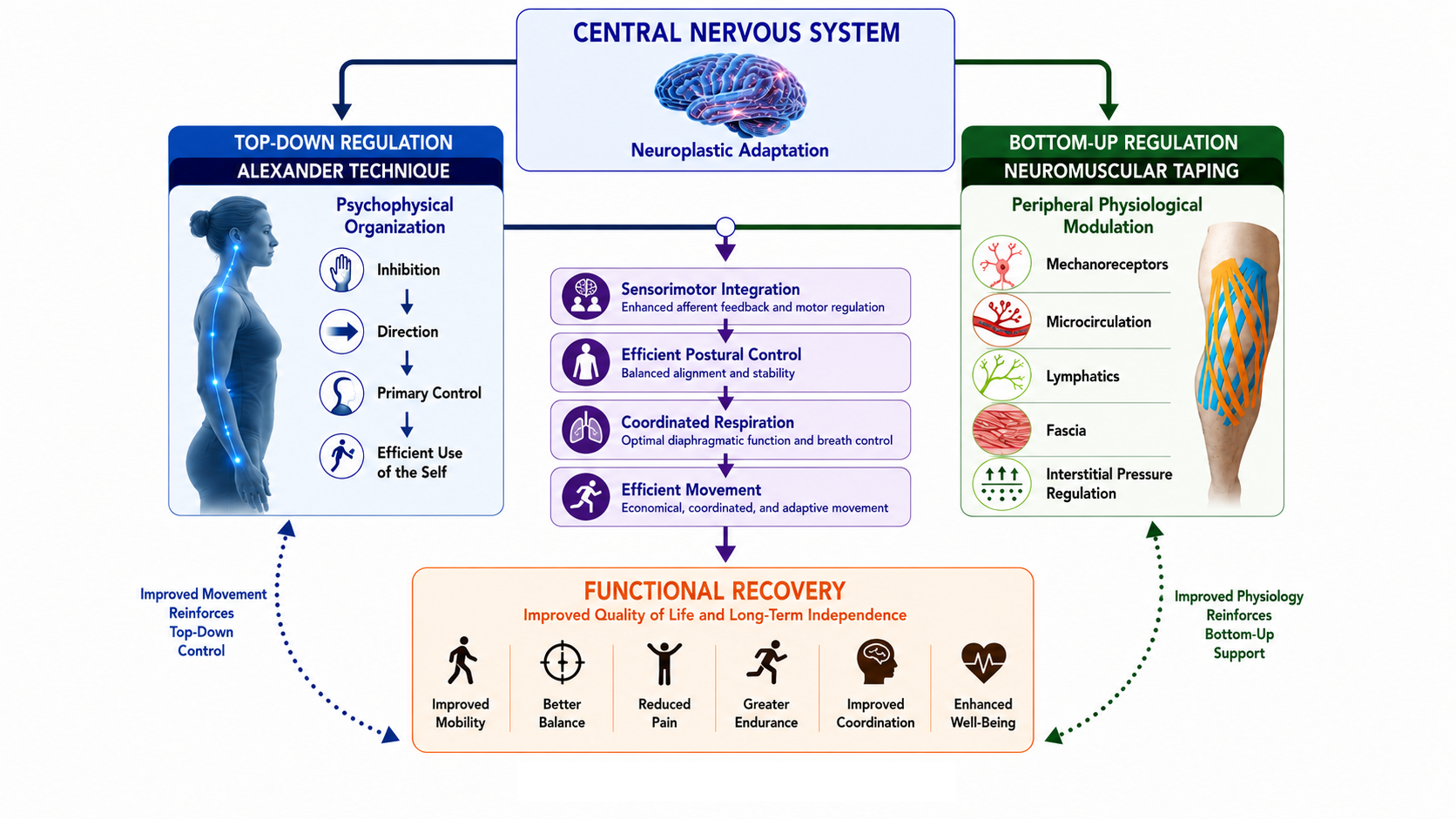
This review offers an Integrated Neurorehabilitation Model combining the bottom-up Peripheral Physiological Modulation provided by NMT with the top-down Psychophysical Organization developed through the Alexander Technique. It is hypothesized that the continuous peripheral sensory input and improved tissue environment associated with NMT may create more favourable conditions for the awareness, inhibition, postural organization, and movement refinement central to Alexander Technique practice. Conversely, more efficient psychophysical organization may support the physiological benefits of NMT by reducing unnecessary muscular activity and improving movement and respiratory coordination. Rather than proposing that either approach acts through a single mechanism, the model considers functional recovery as the result of reciprocal interactions among vascular, lymphatic, fascial, sensorimotor, autonomic, postural, and cognitive processes. This framework provides a rationale for future clinical research investigating the combined application of NMT and the Alexander Technique in neurological and musculoskeletal rehabilitation.
Peripheral Physiological Modulation through NeuroMuscular Taping
Mechanisms of NeuroMuscular Taping: NeuroMuscular Taping (NMT) may be conceptualized as a form of peripheral physiological modulation, in which continuous mechanical decompression of the skin and superficial fascia influences multiple interacting biological systems rather than producing a single localized therapeutic effect. Through its characteristic application without tension, NMT creates visible skin convolutions that increase interstitial space, modify local pressure gradients, and generate continuous low-threshold sensory stimulation (Blow D., 2013). These biomechanical changes simultaneously influence microcirculation, lymphatic drainage, fascial mobility, mechanoreceptor activation, interstitial fluid dynamics, and sensorimotor regulation, establishing a physiological environment that supports functional recovery and adaptive mechanisms that may contribute to adaptive neuroplastic changes.
Instead of acting solely as an external support, NeuroMuscular Taping functions as a continuous source of peripheral sensory and physiological information. The interaction between tissue decompression and sustained cutaneous stimulation provides ongoing afferent input to the central nervous system while optimizing the mechanical and metabolic conditions necessary for efficient movement. These peripheral mechanisms form the physiological foundation upon which higher-order processes of postural regulation, motor coordination, and psychophysical organization can develop.
Mechanoreceptors and Sensorimotor Modulation
The application of NeuroMuscular Taping produces continuous, low-threshold cutaneous stimulation through its characteristic decompressive effect on the skin. By creating convolutions and increasing interstitial space, NMT alters the mechanical environment of the dermal and subdermal tissues, resulting in sustained activation of cutaneous mechanoreceptors, including Merkel cells, Ruffini endings, hair follicle receptors, and other low-threshold tactile afferents. These receptors detect stretch, pressure, skin deformation, and shear forces, contributing to continuous modulation of afferent sensory input directed toward the central nervous system (Abraira et al., 2013; Lumpkin et al., 2010; Zimmerman et al., 2014).
This afferent modulation influences both segmental spinal reflexes and supraspinal processing, enhancing proprioceptive awareness and improving the quality of motor output. Unlike intermittent manual therapies, the continuous sensory stimulation generated by NMT provides an ongoing proprioceptive reference that assists the nervous system in refining body orientation, joint position sense, postural regulation, and movement coordination. From a functional perspective, this contributes to improved postural stability, movement efficiency, and neuromuscular control, particularly in individuals presenting with impaired proprioception or altered sensorimotor regulation (Proske & Gandevia, 2012).
These peripheral sensory mechanisms closely complement the educational principles of the Alexander Technique. Enhanced sensory feedback generated by NMT may improve an individual’s ability to perceive habitual patterns of excessive muscular tension, inefficient posture, and maladaptive movement strategies. By providing clearer and more consistent proprioceptive information, NMT may facilitate the conscious processes of inhibition, direction, and improved Primary Control that form the foundation of Alexander Technique practice, allowing individuals to recognize and modify inefficient motor habits with greater precision.
In neurological disorders—including Stroke, Parkinson’s disease, and Multiple Sclerosis—disrupted sensorimotor integration is a major limitation to functional recovery. Altered afferent feedback interferes with motor planning, postural organization, anticipatory postural adjustments, and movement execution, leading to compensatory strategies, increased energy expenditure, and reduced functional performance. In these situations, the enhanced peripheral sensory input generated by NMT may improve the quality and consistency of proprioceptive information reaching cortical and subcortical motor centres. Simultaneously, the Alexander Technique facilitates conscious refinement of movement organization by reducing unnecessary muscular activity and improving postural coordination during functional tasks.
From a neurophysiological perspective, these complementary mechanisms align closely with contemporary models of neuroplasticity and predictive motor control, in which repeated, meaningful sensory experiences combined with conscious modulation of movement promote cortical reorganization and functional recovery. Enriched sensory input facilitates synaptic adaptation, improves cortical representation of the body, and enhances motor relearning following neurological injury (Johansson, 2011; Carey, 2012). By continuously modulating cutaneous afferent input, NMT may therefore enhance the effectiveness of the psychophysical re-education provided by the Alexander Technique, creating favourable conditions for adaptive neural plasticity and more efficient movement organization (Albizzati et al., 2020).
The decompressive action of NMT reduces local nociceptive input by decreasing interstitial pressure and minimizing mechanical irritation of free nerve endings. Reduced pain-related afferent signalling decreases protective muscular guarding, improves movement confidence, and facilitates more efficient neuromuscular activation. This reduction in unnecessary muscular tension closely reflects the objectives of the Alexander Technique, which seeks to minimize excessive effort and restore coordinated movement through conscious inhibition of maladaptive habitual responses. Together, these complementary mechanisms optimize the sensorimotor system by integrating peripheral sensory modulation with conscious psychophysical organization to improve posture, movement efficiency, and functional performance.
Integrated Neurorehabilitation Model: A Systems-Based Approach
The integration of NeuroMuscular Taping (NMT) and the Alexander Technique provides the basis for a systems-based rehabilitation model in which Peripheral Physiological Modulation and Psychophysical Organization address different but interacting aspects of movement and recovery. NMT acts primarily on the peripheral tissue and sensory environment, while the Alexander Technique works with how the individual perceives, organizes, and responds during movement. The proposed model considers these processes as part of an ongoing interaction between tissue physiology, sensory information, motor control, cognition, posture, and breathing.
Within this framework, NMT provides continuous bottom-up peripheral modulation through decompression and sustained cutaneous stimulation. Its proposed effects include changes in mechanoreceptor input, interstitial pressure, microcirculation, lymphatic dynamics, fascial mobility, and local tissue conditions. Rather than assuming that these changes directly improve motor control, they may be understood as modifying the physiological and sensory environment from which movement is organized. Reduced pain, congestion, or tissue restriction may also remove some of the peripheral constraints that contribute to protective muscular activity and compensatory movement.
An example of this sensory–motor relationship was reported by Rigoldi et al. (2015) in adolescents with Down syndrome. Following a single application of NMT to the hand and fingers, changes were observed in aspects of fine motor performance and handwriting. Although the findings relate to an acute intervention and should be interpreted cautiously, they suggest that altering peripheral sensory input can be associated with measurable changes in fine motor behaviour. This is relevant to the present model because it provides a clinical example of how a peripheral intervention may influence the way a functional motor task is performed.

Conclusion
This paper proposes an Integrated Neurorehabilitation Model that brings together Peripheral Physiological Modulation through NeuroMuscular Taping (NMT) and Psychophysical Organization through the Alexander Technique. The two approaches act at different but interacting levels of human function. NMT modifies aspects of the peripheral mechanical, fluid, and sensory environment through cutaneous decompression, changes in interstitial pressure, microcirculation and lymphatic dynamics, tissue mobility, and sustained sensory stimulation. The Alexander Technique addresses how the individual responds within this environment through awareness, inhibition, direction, Primary Control, and the reduction of unnecessary effort during posture, breathing, and movement.
See the full article on ResearchGate
Ready to Advance Your Clinical Skills?
Are you interested in enrolling in a NeuroMuscular Taping (NMT) course? The NMT Institute offers internationally accredited certification programs across a wide range of clinical fields, including:
- Physical rehabilitation
- Neurology
- Oncology and post-surgical rehabilitation
- Sports therapy and athletic training
- Occupational and speech therapy
- Remedial education and nursing
- Vascular and lymphedema treatment and management
All NMT courses are delivered in-person in classroom settings, ensuring hands-on skill development, enhanced clinical reasoning, and optimal therapeutic outcomes. Online courses are not available, as practical application is central to the NMT therapeutic system.
To view upcoming course dates, detailed programs, and registration options, please contact your local course provider or visit the NMT Institute Website.

Are you interested in enrolling in an NMT Course?
The NeuroMuscular Taping Institute provides certification courses in physical rehabilitation, neurology, oncology, post surgical rehab, occupational therapy, speech therapy, remedial therapy, nursing as well vascular and lymphedema treatment and management. All trainings are classroom settings to enhance skill development and clinical reasoning creating optimum therapeutic results. ONLINE courses are not available. Please contact your local course provider or visit the NMT WEB SITE for course programs and dates.
For more details, course listings, and registration for an upcoming course CLICK HERE
Do you require validation of your NMT methodology for research purposes?
A detailed Neuromuscular Taping methodology is crucial in any research project for several reasons. Repeatability, Transparency, Validity and Reliability of your treatment choices will not only have an impact on your research but also an impact on future therapeutic choices. For more detailed information about the NMT, please contact us at: info.taping@mail.com
Know someone who might be interested in this newsletter? Share it with them.