Pediatric clubfoot rehabilitation is essential to restoring mobility, preventing lifelong disability and improving quality of life for children born with congenital talipes equinovarus (clubfoot). In Africa, where access to specialized orthopedic care is often limited, early diagnosis, multidisciplinary treatment and innovative rehabilitation strategies—including NeuroMuscular Taping (NMT) as an adjunct where clinically appropriate—can help optimize functional outcomes while strengthening local rehabilitation services.
Understanding Therapeutic Taping Methodologies
Congenital clubfoot (Congenital Talipes Equinovarus) is one of the most common congenital musculoskeletal deformities affecting children worldwide and remains a significant public health challenge in many African countries. Without timely treatment, children may experience severe mobility limitations, pain, social exclusion and long-term disability. Therefore, early identification and access to evidence-informed rehabilitation are critical to achieving optimal functional outcomes.
Pediatric clubfoot rehabilitation requires a multidisciplinary approach that combines orthopedic assessment, conservative management such as the Ponseti method when appropriate, surgical intervention for complex cases, physiotherapy and long-term functional rehabilitation. Furthermore, NeuroMuscular Taping (NMT) may be integrated as an adjunctive rehabilitation strategy during selected phases of recovery to support tissue mobility, proprioceptive stimulation, movement quality and functional rehabilitation when clinically indicated. Beyond individual patient care, expanding professional education and strengthening rehabilitation services are essential to improving access to high-quality treatment for children living with clubfoot across Africa.
Pediatric Clubfoot is a significant public health concern in Africa, where many children face mobility challenges due to limited access to early diagnosis and treatment. While the PonsetiMethod remains the gold standard, barriers such as financial constraints, healthcare infrastructure gaps, and lack of awareness often hinder its success. By integrating innovative, cost-effective solutions like NeuroMuscularTaping (NMT), we can enhance treatment outcomes, improve mobility, and provide a more accessible approach to managing clubfoot in underserved regions.
Challenges in Treating Clubfoot in Africa
Several barriers hinder the effective management of clubfoot in Africa. One of the primary challenges is limited access to healthcare, particularly in rural communities, where there is a shortage of pediatric orthopedic specialists. This makes early intervention difficult, often leading to delayed or inadequate treatment. Additionally, financial constraints present a significant hurdle, as many families struggle to afford repeated hospital visits or prolonged therapies required for successful treatment.
Another major issue is the lack of awareness surrounding clubfoot, leading to misconceptions and a lack of timely intervention. Many communities do not recognize the condition as treatable, which results in children growing up with preventable disabilities. Furthermore, infrastructure and training gaps exacerbate the problem, as there is a shortage of trained healthcare providers specializing in clubfoot management. Without adequate training and resources, many children do not receive the necessary medical attention to correct their condition effectively.
Conventional Treatment Approaches
The Ponseti Method is the gold standard for clubfoot treatment, involving:
- Gentle manipulations and serial casting to gradually correct the foot position.
- Achilles tenotomy (in many cases) to release the tight tendon.
- Bracing with foot abduction orthoses to prevent recurrence.
However, adherence to bracing remains a challenge due to practical and financial constraints, as well as a lack of follow-up care during youth and adult development. In some areas, recurrence rates reach up to 60% after initial therapy.
The Role of NeuroMuscular Taping (NMT) in Clubfoot Treatment
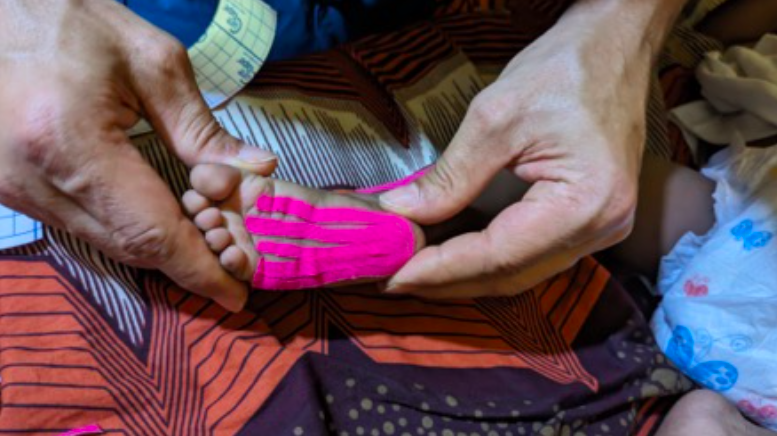
NeuroMuscular Taping (NMT) offers a non-invasive, cost-effective approach that can be integrated into clubfoot management to enhance treatment outcomes.
Benefits of NMT in Clubfoot Management:
- Supports Joint Alignment: Applying NMT to affected areas provides continuous biomechanical support, assisting in proper foot positioning.
- Enhances Circulation and Lymphatic Drainage: This reduces swelling, stiffness, and pain, facilitating better movement.
- Reduces Muscle Imbalance: Helps relax overactive muscles while stimulating weaker muscles, contributing to gradual foot correction.
- Improves Soft Tissue Elasticity: Supports functional mobility and helps reduce scar adhesions post-tenotomy.
- Increases Patient Compliance: Unlike rigid bracing, taping is comfortable, easy to apply, and allows for continued mobility.
Integrating NMT with Traditional Approaches
In Africa, where medical infrastructure challenges exist, NMT can complement existing treatments like Ponseti casting and physical therapy. Trained healthcare workers, community health volunteers, and caregivers can learn simple NMT techniques to support long-term management at home.
Moving Forward: Expanding NMT Training and Awareness
To maximize the impact of NeuroMuscular Taping for clubfoot in Africa, we need:
- Training Programs: Educating physiotherapists, occupational therapists, and caregivers on proper taping techniques.
- Community Outreach: Raising awareness about early diagnosis and treatment options.
- Research and Collaboration: Conducting clinical studies to further validate the effectiveness of NMT in clubfoot rehabilitation.
Future Perspectives for Pediatric Clubfoot Care
Pediatric clubfoot remains a public health challenge in Africa, but innovative, accessible interventions like NeuroMuscular Taping provide a promising addition to conventional treatments. By integrating NMT into clubfoot care, we can enhance mobility, improve patient comfort, and support long-term functional recovery, ensuring a better quality of life for affected children.
Let’s work together to bring sustainable and effective clubfoot treatment solutions to underserved communities!
Are you interested in NeuroMuscular Taping Volunteer Projects?
The NMT Volunteer Group is a non-governmental, non-profit organization dedicated to providing medical training and assistance in countries of the Global South (Latin America, Africa, and parts of Asia), Central America, and Eastern Europe. The group consists of international volunteers specializing in healthcare services, each with specific professional expertise, working to transfer essential know-how and improve local healthcare services.

Are you interested in enrolling in an NMT Course?
The NeuroMuscular Taping Institute provides certification courses in physical rehabilitation, neurology, oncology, post surgical rehab, occupational therapy, speech therapy, remedial therapy, nursing as well vascular and lymphedema treatment and management. All trainings are classroom settings to enhance skill development and clinical reasoning creating optimum therapeutic results. ONLINE courses are not available. Please contact your local course provider or visit the NMT WEB SITE for course programs and dates.
For more details, course listings, and registration for an upcoming course CLICK HERE
Do you require validation of your NMT methodology for research purposes?
A detailed Neuromuscular Taping methodology is crucial in any research project for several reasons. Repeatability, Transparency, Validity and Reliability of your treatment choices will not only have an impact on your research but also an impact on future therapeutic choices. For more detailed information about the NMT, please contact us at: info.taping@mail.com
Know someone who might be interested in this newsletter? Share it with them.