NeuroMuscular Taping for Systemic Lupus Erythematosus offers an evidence-informed adjunctive rehabilitation approach designed to complement conventional medical management. By promoting tissue decompression, improving lymphatic drainage, enhancing microcirculation and reducing mechanical stress on painful tissues, NeuroMuscular Taping (NMT) may help alleviate pain, edema, stiffness and functional limitations while supporting mobility and quality of life for individuals living with systemic lupus erythematosus.
Understanding Systemic Lupus Erythematosus
Systemic Lupus Erythematosus (SLE) is a complex autoimmune disease characterized by chronic inflammation, immune dysregulation and multisystem involvement. Beyond its effects on the joints, skin, kidneys, cardiovascular system and central nervous system, many individuals experience persistent pain, edema, fatigue and reduced physical function that significantly affect daily life. Although immunosuppressive therapies have substantially improved disease management, many patients continue to experience symptoms that limit mobility and quality of life.
NeuroMuscular Taping for Systemic Lupus Erythematosus introduces a decompression-based rehabilitation strategy that complements pharmacological treatment through non-invasive physiological mechanisms. Rather than replacing medical therapy, NeuroMuscular Taping (NMT) supports rehabilitation by facilitating lymphatic drainage, improving microcirculation, reducing interstitial pressure and enhancing proprioceptive input. Furthermore, these physiological effects may contribute to pain reduction, improved joint mobility, decreased tissue congestion and better functional performance. By integrating evidence-informed rehabilitation with multidisciplinary medical care, NeuroMuscular Taping offers clinicians an additional therapeutic option to address the complex rehabilitation needs of people living with SLE.
Pain, Edema and Functional Limitations in SLE
Rare diseases, though individually uncommon, collectively affect millions of people worldwide and often carry significant morbidity, disability, and reduced quality of life. Among them, Systemic Lupus Erythematosus (SLE) is a chronic autoimmune disease that can involve multiple organ systems and present with highly variable severity. Pediatric SLE, in particular, tends to follow a more aggressive course than adult-onset disease, with greater risks of nephritis, serositis, hematological complications, and long-term organ damage (Tucker & Mak, 2005; Mina & Brunner, 2013). Beyond systemic inflammation, lymphatic dysfunction has been observed in SLE, manifesting as pleural and pericardial effusions, chylous ascites, or peripheral edema, all of which can cause significant pain, impaired mobility, and psychosocial distress (Zhou et al., 2019; Bhatnagar et al., 2019).
Despite advances in immunosuppressive therapy, many symptoms—especially pain and edema—remain difficult to manage. Patients who fail to respond to conventional treatment may be subjected to escalating doses of corticosteroids and cytotoxic agents, exposing them to long-term adverse effects without guaranteed relief (Hahn et al., 2012). Thus, there is a clear need for adjunctive, non-invasive therapies that complement medical care and reduce reliance on pharmacological escalation.
NeuroMuscular Taping and Tissue Decompression
NeuroMuscular Taping (NMT) represents one such adjunctive approach. Unlike traditional compression taping, NMT applies elastic tape eccentrically to pre-stretched skin, creating a decompressive lifting effect. This biomechanical action:
- Reduces pain by lowering pressure on nociceptors and modulating sensory input (Blow, 2012; Parisi et al., 2017, Maggi et al., 2021).
- Improves lymphatic drainage, facilitating clearance of inflammatory mediators and reducing edema (Conejo et al., 2018, Blow d 2014).
- Enhances motor function by decreasing stiffness, restoring joint mobility, and supporting muscle activation through proprioceptive feedback (Parisi et al., 2017, Camerota et al., 2014, Costantino et al., 2016).
- Reduces inflammation and aids in tissue regeneration by (Vallelunga et al., 2017, Kristianto H et al., 2024)
- May help limit unnecessary overmedication by providing symptomatic relief where pharmacological therapies alone may be insufficient, reducing the need for higher drug dosages or additional agents.
Evidence from postoperative care and oncology rehabilitation supports NMT’s effectiveness in reducing swelling and pain after knee arthroplasty (Albizzati et al., 2020), breast cancer surgery with axillary lymph node dissection and breast reconstruction surgery. These findings suggest that NMT could also benefit patients with rare autoimmune diseases such as SLE, systemic sclerosis, and juvenile dermatomyositis, where edema, pain, and mobility loss are central to the clinical picture.
Integrating NeuroMuscular Taping into Multidisciplinary Lupus Care
The present case study describes the application of NMT in a 14-year-old girl with severe pediatric SLE, highlighting its potential role in pain relief, edema management, and functional improvement. This example underscores the importance of exploring adjunctive strategies in rare disease rehabilitation to improve outcomes while minimizing the burden of pharmacological overexposure.
The 9th Asia-Oceanian Conference of Physical and Rehabilitation Medicine in conjunction with the 16th Annual Malaysian Rehabilitation Medicine Conference 21st–23rd August 2025 | Penang, Malaysia
Case Study: NeuroMuscular Taping as an Adjunctive Intervention for Painful Lower Limb Edema in Pediatric Systemic Lupus Erythematosus (SLE)
Authors: Anindya Khairunnisa Zahra, Afrilia Intan Pratiwi, David Leonard Blow
Background: Systemic Lupus Erythematosus (SLE) is a chronic autoimmune disease with a global prevalence in children ranging from 3.3 to 24 per 100,000. Pediatric-onset SLE typically follows a more aggressive course than adult-onset disease, with higher risks of multiorgan involvement and irreversible damage. Lymphatic dysfunction has been reported in SLE, including rare cases of chylous ascites, pleural effusions, and peripheral lymphatic obstruction, all of which severely impair quality of life.
This case study describes a 14-year-old girl with pediatric SLE who presented with refractory painful lower limb edema and highlights the beneficial role of NeuroMuscular Taping (NMT) as an adjunctive therapeutic intervention.
Case Presentation: A 14-year-old female presented with one month of progressive dyspnea and bilateral lower limb edema, worsening acutely two days prior to admission. After five days of inpatient care, dyspnea improved, but severe lower limb edema and pain persisted. She described her pain as “legs on the verge of exploding” (Numeric Rating Scale, NRS = 8), exacerbated by touch, movement, and weight-bearing.
Clinical findings included:
- General: Normal vital signs, nonscarring alopecia, malar rash
- Musculoskeletal: Bilateral lower limb edema, severe pain, ankle joint stiffness
- Laboratory: ANA positive, elevated anti-dsDNA, hypocomplementemia (low C3, C4), positive Coomb’s test (2+), Hb 8.8 g/dL, albumin 2.95 g/dL, vitamin D 5.3 ng/mL, potassium 2.3 mmol/L
- Imaging: Chest X-ray and echocardiography revealed bilateral pleural effusion and mild pericardial effusion
- Diagnosis: Severe pediatric SLE with serositis, lupus nephritis, and autoimmune hemolytic anemia
Treatment was initiated with hydroxychloroquine, glucocorticoids, mycophenolate mofetil, cyclophosphamide, mesna, diuretics, folic acid, vitamin D, and potassium chloride, in accordance with SLE treatment protocols.

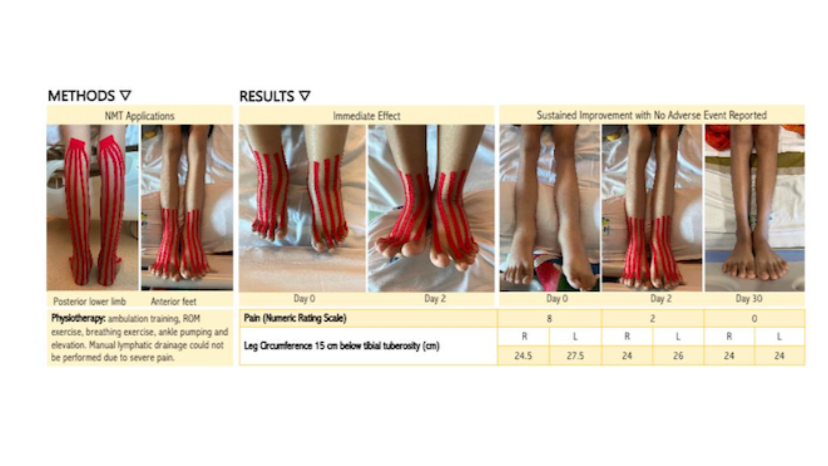
Methods: As conventional treatment failed to alleviate the painful edema, NeuroMuscular Taping (NMT) was introduced as an adjunctive rehabilitation intervention. Decompressive lymphatic applications of elastic tape were applied bilaterally from the anterior foot and ankle to the popliteal fossa. NMT works through a decompressive technique that microscopically lifts the skin, thereby:
- Increasing interstitial space
- Facilitating blood flow and lymphatic drainage
- Reducing nociceptor pressure and pain
- Providing beneficial sensory input
Results:
- Pain: NRS reduced from 8 (baseline, T0) → 2 (after 2 days, T1) → 0 (after 30 days, T2)
- Edema: Leg circumference (15 cm below the tibial tuberosity) decreased and achieved symmetry bilaterally
Discussion: This case illustrates the challenge of managing refractory edema and pain in pediatric SLE, where conventional medical therapy alone may be insufficient. NMT demonstrated rapid pain reduction and resolution of limb asymmetry, suggesting its potential as a supportive therapy for lymphatic dysfunction in SLE. Although the evidence base in autoimmune diseases remains limited, previous studies have shown NMT’s efficacy in reducing postoperative edema and pain in conditions such as knee arthroplasty and breast cancer surgery.
Conclusion: NeuroMuscular Taping may represent a safe, non-invasive, and feasible adjunct for managing painful lower limb edema in pediatric SLE. Larger clinical studies are warranted to establish its role within integrative rehabilitation protocols for autoimmune conditions.
References
- Albizzati Erica, Claudio Trotti, David Blow, Forte Fabiana. NeuroMuscular Taping (NMT) and Neuroplasticity: NMT reduces pain, edema and influences proprioceptive cognitive strategies during total knee arthroplasty rehabilitation. Journal of Physiotherapy & Physical Rehabilitation, 2(6), 120-126). DOI: 10.5281/zenodo.3934948
- Bhatnagar, S., Kumar, S., Yadav, P. K., & Sharma, V. (2019). Chylous ascites in systemic lupus erythematosus: A rare case report. Lupus, 28(13), 1586–1589. https://doi.org/10.1177/0961203319872612
- Blow, D. (2012). NeuroMuscular Taping: From Theory to Practice. Edi Ermes, Milan
- Blow D. Neuromuscular taping : treatment of edemas, hematomas and scars. (2014) Milan: Edi.Ermes; 2018. ISBN:9788870515992
- Camerota F, Galli M, Cimolin V et al (2015) The effects of neuromuscular taping on gait walking strategy in a patient with joint 11. 12. 13. 14. 15. hypermobility syndrome/Ehlers–Danlos syndrome hypermobility type. Ther Adv Musculoskelet Dis 7:3–4. https:// doi. org/ 10. 1177/17597 20X14 564561
- Camerota F, Galli M, Cimolin V et al (2014) Neuromuscular taping for the upper limb in cerebral palsy: a case study in a patient with hemiplegia. Dev Neurorehabil 17:384–387. https:// doi. org/10. 3109/ 17518 423. 2013. 830152
- Conejo I, Pajares B, Alba E, Cuesta-Vargas AI. Effect of neuromuscular taping on musculoskeletal disorders secondary to the use of aromatase inhibitors in breast cancer survivors: a pragmatic randomised clinical trial. BMC Complement Med Ther 2018; 18:180. https://doi.org/10.1186/s12906-018-2236-3
- Costantino C, Pedrini MF, Licari O. Neuromuscular taping versus sham therapy on muscular strength and motor performance in multiple sclerosis patients. Disability and rehabilitation. 2016;38(3):277-81. https://doi.org/10.3109/09638288.2015.1038365
- Hahn, B. H., McMahon, M. A., Wilkinson, A., et al. (2012). American College of Rheumatology guidelines for screening, treatment, and management of lupus nephritis. Arthritis Care & Research, 64(6), 797–808. https://doi.org/10.1002/acr.21664
- Kristianto H, Celletti C, Waluyo A et al. Diabetic foot ulcer treatment management with lymphatic neuromuscular taping (NMT). Clin Ter 2021; 172(2):87–90. https://doi.org/10.7417/CT.2021.2289
- Kristianto H et al. Effects of neuromuscular taping form I on wound temperature and erythema in diabetic foot ulcer: a preliminary study. Journal of Wound Care. Vol. 33, No. 6. 6 Jun 2024 https://doi.org/10.12968/jowc.2020.0291
- Maggi Loredana, Claudia Celletti, Maurizio Mazzarini, David Blow, Filippo Camerota. Neuromuscular taping for chronic non‑specific low back pain: a randomized single‑blind controlled trial. Aging Clinical and Experimental Research 2021. https://doi.org/10.1007/s40520-021-02029-0
- Mina, R., & Brunner, H. I. (2013). Pediatric lupus—are there differences in presentation, genetics, response to therapy, and damage accrual compared with adult lupus? Rheumatic Disease Clinics of North America, 36(1), 53–80. https://doi.org/10.1016/j.rdc.2009.12.002
- Parisi S, Cellen C, ScaraJ M, Priora M, Laganà A, Peroni CL, Camerota F, La Torre G, Blow D, Fusaro E. Neuromuscular taping enhances hand funcJon in patents with systemic sclerosis: a pilot study. Clin Ter. 2017 Nov-Dec;168(6):e371-e375. doi:10.7417/T.2017.2036 PMID: 29209686.
- Tucker, L. B., & Mak, S. (2005). Juvenile systemic lupus erythematosus. Current Opinion in Rheumatology, 17(5), 568–575. https://doi.org/10.1097/01.bor.0000172807.86985.f4
- Zhou, H., et al. (2019). Lymphatic system involvement in systemic lupus erythematosus. Autoimmunity Reviews, 18(5), 495–502. https://doi.org/10.1016/j.autrev.2019.02.001
- Vallelunga A, Berlingieri C, Ragusa M, et al. Physical rehabilitation modulates microRNAs involved in multiple sclerosis: a case report. Clinical case reports. 2017; 5(12):2040-3. https://doi.org/10.1002/ccr3.1100

Are you interested in enrolling in an NMT Course?
The NeuroMuscular Taping Institute provides certification courses in physical rehabilitation, neurology, oncology, post surgical rehab, occupational therapy, speech therapy, remedial therapy, nursing as well vascular and lymphedema treatment and management. All trainings are classroom settings to enhance skill development and clinical reasoning creating optimum therapeutic results. ONLINE courses are not available. Please contact your local course provider or visit the NMT WEB SITE for course programs and dates.
For more details, course listings, and registration for an upcoming course CLICK HERE
Do you require validation of your NMT methodology for research purposes?
A detailed Neuromuscular Taping methodology is crucial in any research project for several reasons. Repeatability, Transparency, Validity and Reliability of your treatment choices will not only have an impact on your research but also an impact on future therapeutic choices. For more detailed information about the NMT, please contact us at: info.taping@mail.com
Know someone who might be interested in this newsletter? Share it with them.