NeuroMuscular Taping for lymphatic treatment represents an innovative rehabilitation methodology developed to improve physiological fluid movement through tissue decompression rather than compression. Introduced in Rome, Italy, in 2000, the NeuroMuscular Taping (NMT) concept transformed lymphatic rehabilitation by combining clinical reasoning with biomechanical principles that enhance lymphatic drainage, microcirculation and functional recovery while preserving normal movement.
The Birth of NeuroMuscular Taping
The evolution of modern lymphatic rehabilitation has increasingly emphasized therapeutic strategies that support the body’s natural physiological mechanisms rather than relying solely on external compression. NeuroMuscular Taping for lymphatic treatment emerged from this concept as a decompression-based rehabilitation methodology designed to improve lymphatic drainage, microcirculation and tissue oxygenation by reducing interstitial pressure and optimizing fluid dynamics.
Why Lymphatic Treatment Required a New Approach
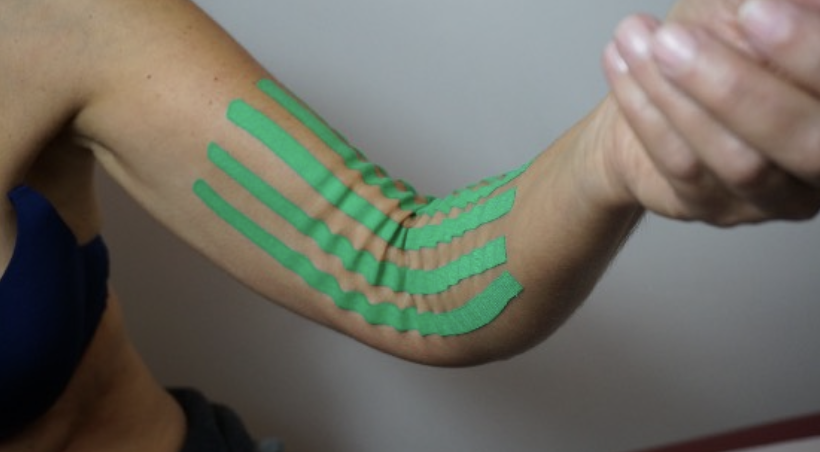
Unlike conventional taping systems that primarily apply compression through stretched elastic tape, NeuroMuscular Taping (NMT) introduced a fundamentally different biomechanical principle based on eccentric application and tissue decompression. Furthermore, by applying elastic tape without tension to skin positioned in maximal elongation, characteristic skin convolutions are created that gently lift the superficial tissues, increasing interstitial space and facilitating lymphatic and venous flow. As a result, this innovative methodology has become an internationally recognized rehabilitation approach used in lymphatic, musculoskeletal, neurological and post-surgical rehabilitation. This article explores the origin, scientific development and clinical evolution of NeuroMuscular Taping for lymphatic treatment, highlighting the principles that distinguish it from other taping methodologies.Differentiating NMT from Other Taping Methods
Decompression Versus Compression
A common misconception persists that all taping systems—“Kinesiology taping, Kinesio taping, elastic taping, or rigid bandaging—are essentially the same”. This misunderstanding reduces therapeutic methodology to the material of the tape rather than acknowledging the critical differences in application strategies.
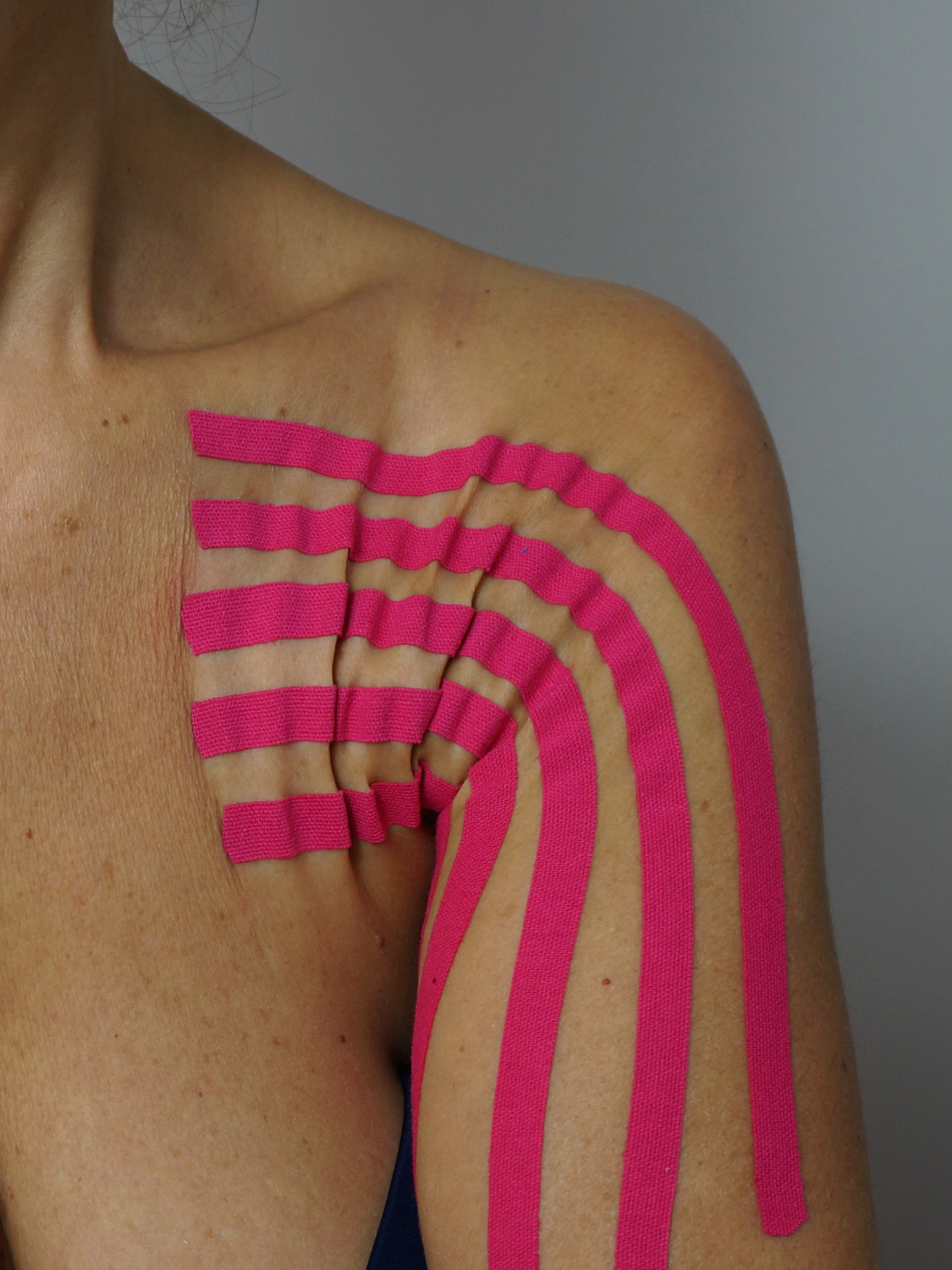
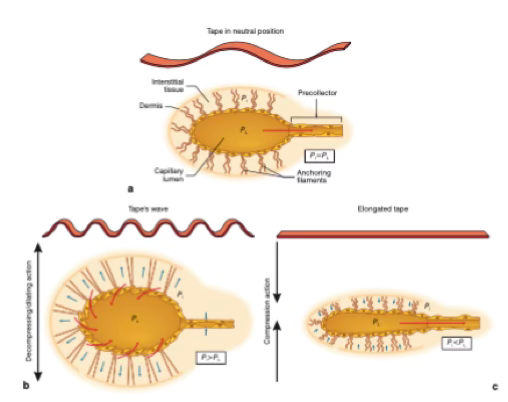
NMT distinguishes itself by focusing on eccentric decompression, whereas all other taping systems apply compression through stretched tape. In practice, this means that NMT tape is applied to pre-stretched skin and tissues without tension on the tape itself, creating a lifting effect. This decompression forms small undulations and wrinkles on the skin, increasing subcutaneous space, reducing mechanical stress, and facilitating blood flow, oxygenation, and lymphatic drainage.
This distinction has profound implications: NMT’s dilation action does not merely restrict or support structures, but actively modulates connective and fascial mechanical forces, thereby optimizing fluid dynamics. The result is a method that enhances lymphatic drainage, reduces pain, and accelerates recovery, while preserving freedom of movement essential for rehabilitation.
Tissue Decompression and Fluid Dynamics
The success of NMT in lymphatic treatment is deeply rooted in the physiological understanding of fluid exchange at the microvascular and lymphatic levels. Traditional models emphasized hydrostatic and oncotic pressures as primary determinants of filtration. However, research has shown that the available exchange surface area and the permeability of microvessels are equally crucial.
Pathological conditions such as edema and lymphatic congestion reduce surface area and disrupt this delicate balance. By increasing dilation and exchange surfaces, NMT applications contribute to restoring fluid regulation and supporting the intrinsic “lymphatic pump” mechanisms.
Importantly, permeability is not a fixed value but a dynamic variable, influenced by:
- The health of surrounding tissues
- Local biochemical composition
- Active transport through lymphatic collectors, regulated by intrinsic (contraction) and extrinsic (movement, fascia, muscle activity) forces
Seminal studies (Engeset et al., 1977; Huxley & Scallan, Journal of Physiology) emphasize that the microvascular system is not a passive barrier but a multicellular, adaptable structure, responsive to inflammation, trauma, hypoxia, and normal body mobilization. NMT directly integrates with these physiological mechanisms, amplifying natural processes of dilation, constriction, and pressure regulation.
Why Eccentric Stimulation?
The lymphatic system is unique in that it lacks a central pump like the heart. Instead, its function relies on constant fluctuations in tissue pressure, body movement, and muscular activity.
- Terminal lymphatic sacs: These are passive structures anchored to the interstitial matrix by collagen and elastin fibers, which possess elastic capacity activated by movement.
- Lymphatic collectors: These structures behave similarly to venules, contributing to net fluid and solute exchange.
- Dynamic fluid mechanics: Unlike static models, the human body maintains perpetual motion through respiration, heartbeats, posture, and locomotion.
NMT leverages these principles. By applying tape eccentrically, the tape-induced wrinkles and undulations create zones of alternating dilation and constriction during movement. This mechanical modulation stimulates pressure variations necessary to propel interstitial fluid into the lymphatic system, thus enhancing clearance of excess fluid and solutes.
Studies by Clough & Smaje (1978), Schmid-Schönbein (1990), Negrini & Del Fabbro (1999), and Zawieja (2009) reinforce that such mechanical oscillations are central to lymphatic propulsion and fluid balance.
How NeuroMuscular Taping Differs from Other Taping Methods
The guiding hypothesis behind NeuroMuscular Taping is that restoring vascular and lymphatic pressure homeostasis is essential to regulate fluid exchange in a body constantly in motion.
Key elements of the therapeutic model include:
- Mechanical decompression: Reducing pathological pressure (creating negative pressure) on lymphatic vessels congested by edema or trauma.
- Activation through movement: Decompression Taping effects are potentiated by passive mobilization, targeted exercise, or even daily activities.
- Combined dilation–constriction effect: Created by eccentric wrinkles, this effect enhances the function of both circulatory and lymphatic systems.
Through these mechanisms, NMT facilitates edema reduction, improves oxygenation, reduces pain, and accelerates tissue recovery.
The Global Development of NeuroMuscular Taping
The NeuroMuscular Taping method was formally introduced in 2000 by David Blow in Rome, Italy. Conceived as a bio-mechanical therapy, it was designed to provide decompressive stimuli capable of generating positive effects across multiple physiological systems—musculoskeletal, vascular, lymphatic, and neurological.
The eccentric tape application method soon became the defining feature of NMT. The wrinkles created during application were not cosmetic but functional, lifting the skin to modulate pressures and expand exchange surfaces. Over time, clinical observation and trials confirmed its effectiveness in reducing edema, improving mobility, and complementing standard rehabilitation therapies.
Since then, NMT has been progressively integrated into:
- Post-surgical rehabilitation, for reducing swelling and promoting healing
- Oncology care, to support lymphatic recovery after mastectomy or lymph node removal
- Sports medicine, where rapid resolution of edema and bruising is critical
- Chronic vascular and lymphatic pathologies, including lymphedema and venous insufficiency
- Immune system irregularities causing lymphatic edema
Today, NMT is taught internationally and incorporated into multidisciplinary rehabilitation protocols, demonstrating its versatility and effectiveness.
Future Perspectives for Lymphatic Rehabilitation
NeuroMuscular Taping represents a paradigm shift in therapeutic taping methodology. By moving away from compression and restriction and toward decompression, dilation, and dynamic stimulation, it addresses the physiological reality of a body in constant motion.
Its origin in 2000 laid the groundwork for a methodology that continues to expand in clinical application and research validation. In lymphatic treatment specifically, NMT has proven to be a powerful adjunct that restores pressure homeostasis, enhances drainage, and contributes to improved patient outcomes across diverse pathologies.
By combining biomechanical insight with practical rehabilitation techniques, NeuroMuscular Taping has established itself not simply as a taping system, but as a comprehensive therapeutic approach to vascular, lymphatic, and musculoskeletal health.

Are you interested in enrolling in an NMT Course?
The NeuroMuscular Taping Institute provides certification courses in physical rehabilitation, neurology, oncology, post surgical rehab, occupational therapy, speech therapy, remedial therapy, nursing as well vascular and lymphedema treatment and management. All trainings are classroom settings to enhance skill development and clinical reasoning creating optimum therapeutic results. ONLINE courses are not available. Please contact your local course provider or visit the NMT WEB SITE for course programs and dates.
For more details, course listings, and registration for an upcoming course CLICK HERE
Do you require validation of your NMT methodology for research purposes?
A detailed Neuromuscular Taping methodology is crucial in any research project for several reasons. Repeatability, Transparency, Validity and Reliability of your treatment choices will not only have an impact on your research but also an impact on future therapeutic choices. For more detailed information about the NMT, please contact us at: info.taping@mail.com
Know someone who might be interested in this newsletter? Share it with them.