Rotator cuff surgery recovery with NeuroMuscular Taping provides an evidence-informed rehabilitation approach that supports healing from the earliest postoperative stage through functional recovery. By reducing pain, facilitating lymphatic drainage, improving microcirculation and enhancing neuromuscular activation, NeuroMuscular Taping (NMT) complements conventional physiotherapy while preserving the freedom of movement essential for successful tendon repair and shoulder rehabilitation.
Why Rehabilitation Determines Surgical Success
Rotator cuff repair is one of the most frequently performed orthopedic procedures for degenerative tendon tears and traumatic shoulder injuries. Although surgical techniques continue to advance, long-term success depends on carefully planned rehabilitation that protects the repair while progressively restoring mobility, strength and shoulder function. Effective postoperative management requires strategies that minimize pain and edema while promoting tissue healing and neuromuscular recovery.
Rotator cuff surgery recovery with NeuroMuscular Taping introduces a decompression-based rehabilitation strategy that complements conventional physiotherapy throughout every phase of healing. Unlike compression-based taping methods, NeuroMuscular Taping (NMT) gently lifts the skin and superficial fascia, reducing interstitial pressure while improving lymphatic drainage, microcirculation and tissue oxygenation. Furthermore, continuous sensory stimulation enhances proprioception and neuromuscular control without restricting physiological movement. By integrating these mechanisms into a structured rehabilitation program, clinicians can support tendon healing, reduce postoperative complications and accelerate the return to functional shoulder activity.
Rotator cuff repair is among the most commonly performed orthopedic procedures, typically indicated for degenerative tendon tears or acute trauma. While surgical techniques have advanced, successful recovery remains highly dependent on structured, phase-specific rehabilitation. In this context, NeuroMuscular Taping (NMT) has emerged as a powerful, non-invasive adjunct that enhances post-surgical outcomes across all stages of healing.
Unlike traditional taping systems focused on joint restriction or compression, NMT applies a decompressive methodology that reduces mechanical stress, facilitates lymphatic and vascular dynamics, modulates pain, and supports neuromuscular reactivation—all while preserving the freedom of movement essential for functional recovery.
The Three Phases of Rotator Cuff Surgery Recovery
🔹 Phase 1: Acute Phase: Pain and Edema Management (0–4 Days Post-Surgery)
Goals: Reduce pain, manage edema and hematoma, protect the surgical site, and prevent secondary complications.
In the immediate post-operative period, tissue sensitivity is high and patient discomfort often inhibits mobility. NMT can be safely applied 12 to 24 hours after surgery, provided skin integrity is confirmed and post-operative bandaging is minimal.
NMT Objectives:
- Promote lymphatic drainage to reduce post-surgical swelling and hematoma.
- Modulate pain by unloading peripheral nociceptors and fascia.
- Improve vascular perfusion and tissue oxygenation, accelerating internal and cutaneous healing.
- Reduce skin tension and myofascial congestion without interfering with the surgical repair.
Application Techniques:
- Single-strip decompressive taping from the axilla toward the deltoid and upper arm over areas of swelling and bruising.
- Tape is applied with zero stretch on pre-tensioned skin, avoiding sutured incisions and medicated dressings. Fundamental that the tape is applied following the skin’s lines of MEL (Maximum Lines of Skin Elasticity).
- Post-surgical bandages should be minimized, when appropriate, to allow for maximum tape coverage of the affected area.
- Always follow NMT contraindications and precautions as outlined in prior guidelines.
🔹 Phase 2: Post-Acute Phase (4 Days–3 Weeks Post-Surgery)
Goals: Restore passive range of motion, continually reduce pain, reduce residual inflammation, facilitate drainage, and initiate neuromuscular activation.
During this phase, the focus shifts toward controlled mobilization and pain-free range of motion. NMT continues to support drainage and now contributes to scapular alignment and muscle recruitment.
NMT Objectives:
- Support scapular mobility and shoulder girdle alignment.
- Reduce residual pain, edema, and fascial stiffness.
- Enhance neuromuscular coordination across the deltoid, trapezius, rhomboid and rotator cuff muscles.
Application Techniques:
- All applications use decompressive taping with zero tape stretch applied on pre-stretched skin following lines of MEL.
- As wound healing progresses, medicated dressings can be reduced, allowing broader treatment zones.
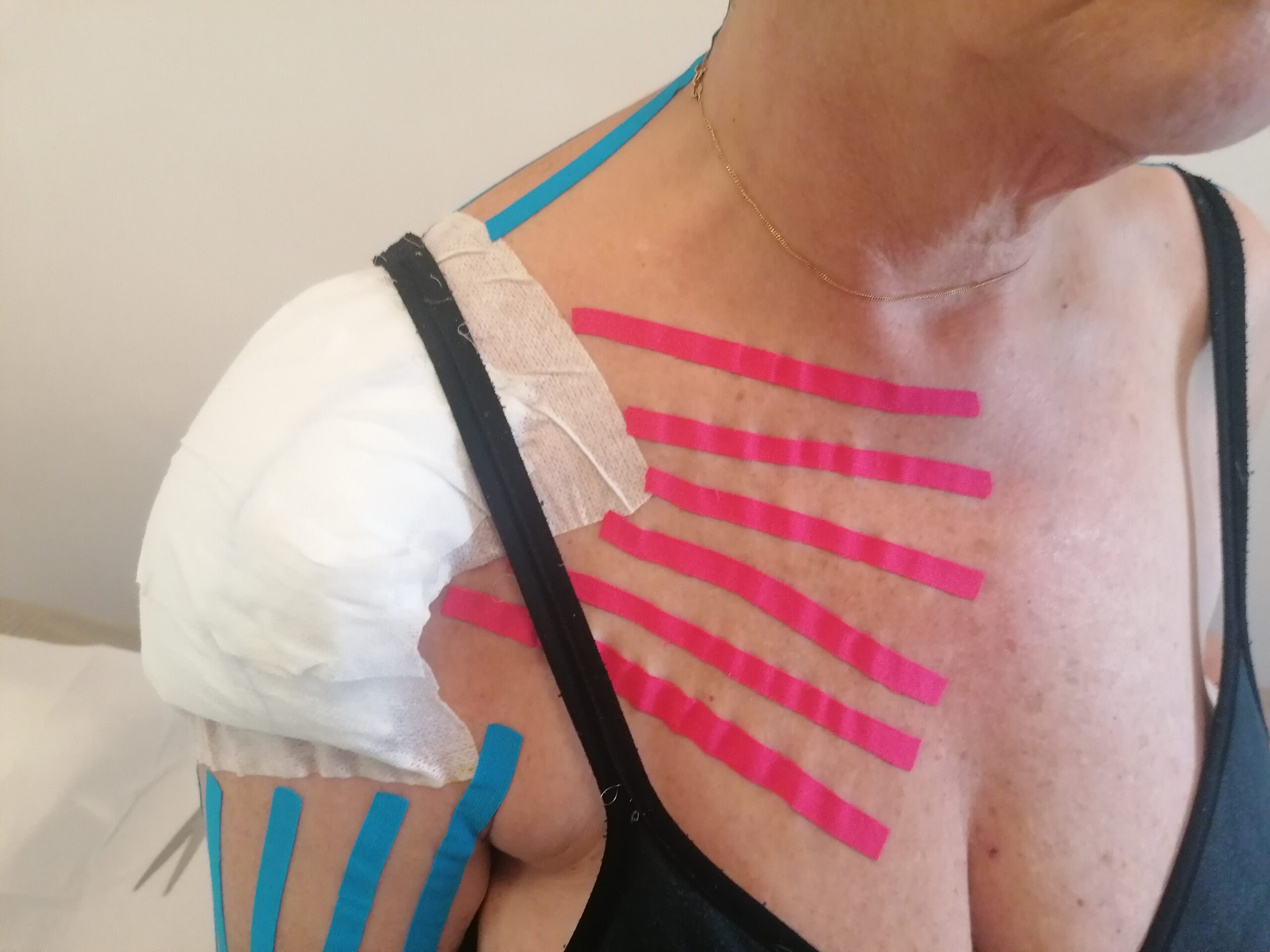
- Use Double Fan Protocol Decompression over the shoulder—applied and replaced biweekly for optimal outcomes.
- Add functional applications for rhomboid and upper trapezius to support scapulothoracic and cervical mobility.
- Include decompressive taping over the pectoralis region to enhance fascial glide and local circulation.
🔹 Phase 3: Functional Phase (3+ Weeks Post-Surgery)
Goals: Restore strength, dynamic shoulder stability, and full upper limb function for daily or athletic activities.
Depending on surgical technique, symptom resolution, and comorbidities, the patient may begin active rehabilitation, including progressive loading and movement retraining. NMT in this phase facilitates neuromuscular control, minimizes compensations, and supports kinetic chain re-integration.
NMT Objectives:
- Enhance motor control and proprioception during progressively complex movements.
- Minimize compensatory overuse in adjacent regions (e.g., cervical spine, upper trapezius).
- Promote muscle balance between the rotator cuff and deltoid to optimize performance and reduce reinjury risk.
Application Techniques:
- Use proprioceptive decompression taping on major muscle groups: deltoid, biceps, trapezius, rhomboid.
- Apply taping to reinforce eccentric loading patterns during strengthening exercises in absence of pain and reduced range of motion.
- Add functional decompressive strips along pectoralis major, teres minor, supraspinatus, and subscapularis pathways to support elongation, prevent adaptive shortening, and normalize scapulohumeral rhythm.
Integrating NeuroMuscular Taping into Postoperative Rehabilitation
NeuroMuscular Taping offers a clinically effective, patient-centered approach by:
- Promotes sustained NMT activation 24/7 through patient-led home exercises and structured mobility routines integrated into daily activities.
- Creating a mechanical lifting effect activated by body movement that enhances fluid exchange and nutrient delivery
- Providing non-invasive pain modulation via neurocutaneous interaction
- Facilitating fascial mobility for improved kinematics and muscle coordination
- Integrating naturally into physiotherapy, manual therapy, and functional rehab programs

Are you interested in enrolling in an NMT Course?
The NeuroMuscular Taping Institute provides certification courses in physical rehabilitation, neurology, oncology, post surgical rehab, occupational therapy, speech therapy, remedial therapy, nursing as well vascular and lymphedema treatment and management. All trainings are classroom settings to enhance skill development and clinical reasoning creating optimum therapeutic results. ONLINE courses are not available. Please contact your local course provider or visit the NMT WEB SITE for course programs and dates.
For more details, course listings, and registration for an upcoming course CLICK HERE
Do you require validation of your NMT methodology for research purposes?
A detailed Neuromuscular Taping methodology is crucial in any research project for several reasons. Repeatability, Transparency, Validity and Reliability of your treatment choices will not only have an impact on your research but also an impact on future therapeutic choices. For more detailed information about the NMT, please contact us at: info.taping@mail.com
Know someone who might be interested in this newsletter? Share it with them.