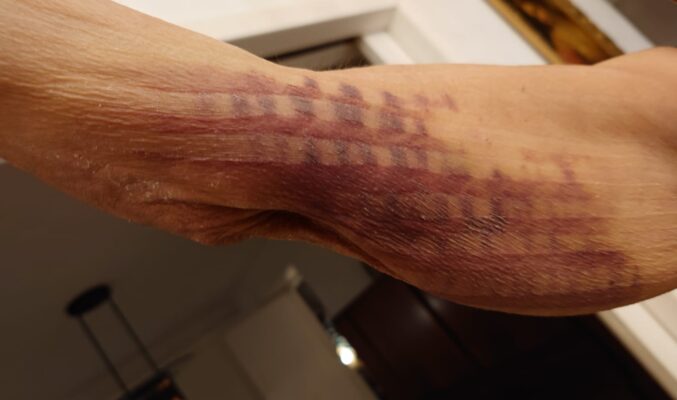
NeuroMuscular Taping for PICC hematoma can be considered as an adjunctive rehabilitation strategy for selected patients who develop localized bruising and edema following peripherally inserted central catheter placement. Using a decompression methodology with 0% therapeutic tape tension, NMT is applied around—but not over or in a manner that interferes with—the catheter insertion site, sterile dressing or fixation system. Its objective is to support the superficial tissue environment and fluid exchange while preserving catheter safety and appropriate medical monitoring.
Oncology rehabilitation
NeuroMuscular Taping After Breast Cancer Surgery: Lymphatic and Functional Rehabilitation
NeuroMuscular Taping after breast cancer surgery provides a decompression-based adjunct to multidisciplinary rehabilitation following lumpectomy, mastectomy, breast reconstruction and lymph node procedures. By applying elastic tape at 0% therapeutic tension to appropriately elongated tissues, NMT creates a dynamic skin–tape interface intended to support superficial tissue mobility, fluid exchange, continuous sensory input and functional movement without restricting physiological motion.
Breast Surgery Rehabilitation – Role of NeuroMuscular Taping
Breast surgery rehabilitation integrates NeuroMuscular Taping to improve lymphatic drainage, scar mobility, pain management, upper limb function and long-term recovery