NeuroMuscular Taping for Stroke Rehabilitation: Sensorimotor and Functional Recovery

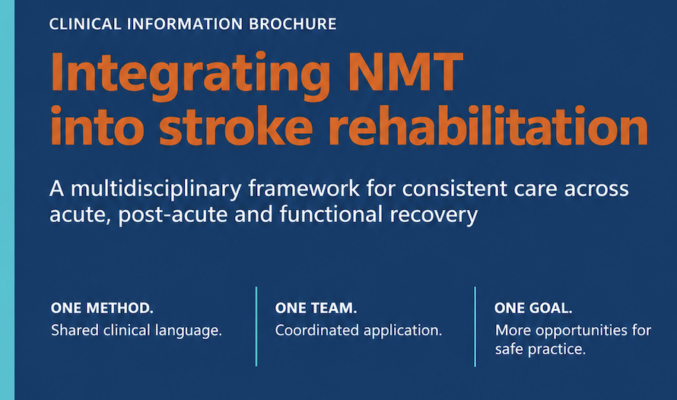
NeuroMuscular Taping for stroke rehabilitation provides a decompression-based adjunct to neurological rehabilitation designed to interact continuously with the patient’s sensory and motor systems during posture and movement. Applied with 0% therapeutic tape tension while the target tissues are appropriately elongated, NMT creates a dynamic skin–tape interface that provides prolonged cutaneous sensory input. Integrated with physiotherapy, occupational therapy, gait training and task-specific rehabilitation, this approach may support proprioception, neuromuscular control, movement organization and functional recovery following stroke.

NeuroMuscular Taping and Alexander Technique: Integrating Bottom-Up and Top-Down Rehabilitation

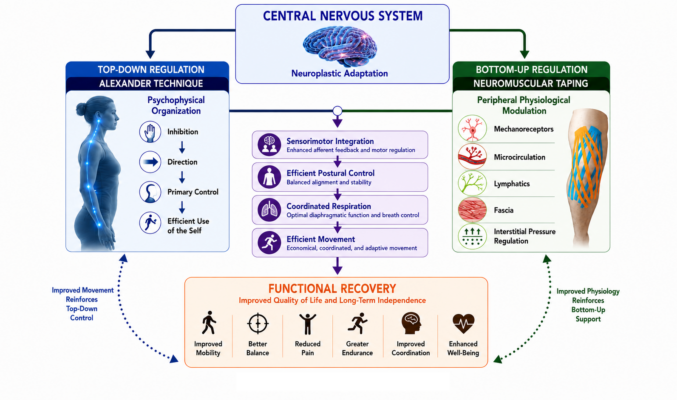
NeuroMuscular Taping and Alexander Technique offer complementary perspectives on rehabilitation by connecting bottom-up physiological and sensory modulation with top-down psychophysical organization. NeuroMuscular Taping (NMT) acts through decompression, continuous cutaneous stimulation and modification of the superficial tissue environment, while the Alexander Technique develops conscious awareness of posture, movement, breathing and habitual motor responses. Their integration provides a systems-based framework for exploring how peripheral sensory conditions and conscious movement organization may interact to support functional recovery.

NeuroMuscular Taping and the Feldenkrais Method: A Synergistic Model for Sensorimotor Rehabilitation

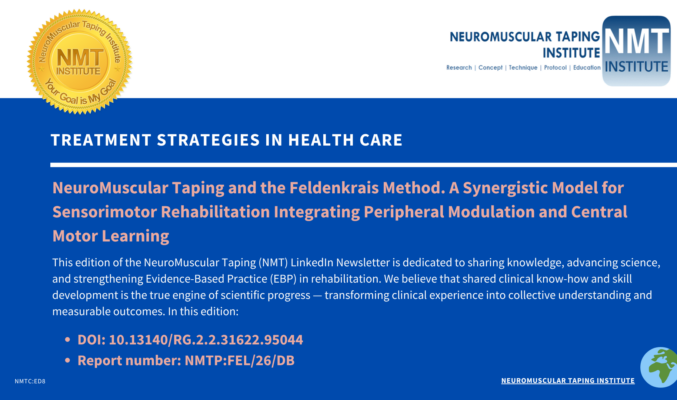
NeuroMuscular Taping and the Feldenkrais Method represent two complementary approaches that address different yet interconnected aspects of human movement and neurological rehabilitation. While NeuroMuscular Taping (NMT) provides continuous peripheral sensory stimulation through decompression, improving lymphatic drainage, microcirculation, proprioception, and neuromuscular coordination, the Feldenkrais Method promotes central motor learning through movement awareness, variability, and neuroplastic adaptation. Integrating these two evidence-informed approaches creates a systems-based rehabilitation model capable of simultaneously influencing tissue physiology, sensorimotor integration, and functional movement.